
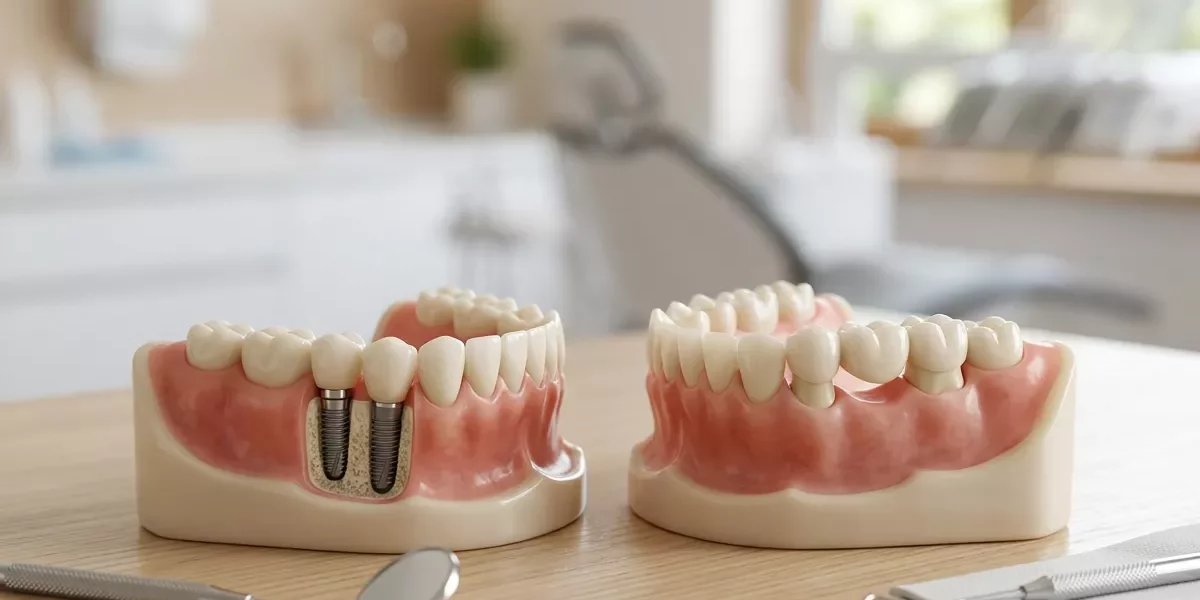
One of the most common questions patients ask after losing a tooth is this: should I get a dental implant or a bridge? It sounds like a simple comparison, but the right answer depends on much more than just price or speed. For most patients, the real goal is not simply to fill a gap. The real goal is to choose the treatment that makes the most sense for their mouth, their long-term comfort, and their future dental health.
This is where many people become confused. A bridge may seem faster. An implant may sound more modern. Friends, online forums, and before-and-after photos often make the decision sound easy. In reality, both treatments can work very well when they are chosen for the right reason. The problem begins when the decision is made too quickly or without a full understanding of the teeth, gums, and bone involved.
A missing tooth affects more than appearance. It can influence chewing, bite balance, neighboring teeth, and even long-term gum and bone stability. That is why choosing between a dental implant and a bridge should not be treated like choosing between two similar cosmetic products. It is a clinical decision that should be based on how the mouth actually functions.
At Milim Dental, this type of decision is not reduced to a quick yes-or-no answer. The question is not which option sounds better online. The question is which option is more suitable for the patient sitting in the chair.
What is the main difference between an implant and a bridge?
A dental implant replaces a missing tooth by placing an artificial root into the jawbone and then building a restoration on top of it. A bridge replaces the missing tooth by using the neighboring teeth as support. In other words, one option gets its support from the bone, and the other gets its support from the teeth next to the gap.
This difference matters more than many patients realize. If the adjacent teeth are completely healthy, using them as support may not always be the ideal first choice. On the other hand, if those teeth already have large fillings or crowns, a bridge may sometimes make more sense than patients expect.
The point is not that one treatment is always superior. The point is that they work according to different biological logic. An implant is usually more independent. A bridge is more connected to the condition of nearby teeth. That is why the same missing tooth can lead to very different treatment recommendations in two different patients.
The best decision starts with understanding this basic difference. Once the patient sees how each option works, the rest of the discussion becomes much clearer.
When may an implant be the better option?
A dental implant may be the better option when the teeth next to the gap are healthy and the missing-tooth area has enough bone and gum support for implant placement. One of the biggest advantages of an implant is that it can often replace the tooth without relying on the neighboring teeth. For many patients, that independence is a major benefit.
This is especially important in single-tooth cases. If the surrounding teeth are untouched and in good condition, many patients prefer the idea of replacing only the missing tooth rather than involving two healthy teeth in the treatment plan. In those situations, implants often feel like a more conservative long-term choice, even though they involve a surgical step.
Implants may also appeal to patients who want a fixed tooth that feels more separate and natural in daily use. Some people like the idea that the replacement is supported by the jaw rather than joined to other teeth. For the right patient, this can improve confidence, comfort, and cleaning habits.
Still, implants are not automatic. Bone volume, gum health, oral hygiene, bite forces, smoking habits, and medical history all affect suitability. That is why a patient should never assume that an implant is the best option simply because implants are popular.
When may a bridge be a more realistic choice?
A dental bridge may still be a very reasonable option in selected cases. For example, if the neighboring teeth already need crowns or already carry large restorations, using them as support may fit naturally into the treatment plan. In that situation, the bridge is not necessarily a compromise. It may actually be a practical and well-matched solution.
Some patients also prefer to avoid implant surgery. Others may have bone or health conditions that make implants less straightforward. In such cases, a bridge can provide a fixed replacement without requiring the same type of surgical planning. That does not make it inferior. It simply means the treatment logic is different.
A bridge may also be considered when treatment timing needs to be simplified for specific reasons. However, convenience alone should not be the only reason to choose it. The support teeth must be carefully evaluated, because the success of the bridge depends heavily on the long-term health of those teeth.
The key is not whether bridges are old-fashioned or implants are advanced. The key is whether the treatment matches the condition of the mouth. Good dentistry is not about trends. It is about suitability.
Which one is better for appearance and daily comfort?
From a patient point of view, appearance and comfort are often just as important as the technical explanation. The good news is that both implants and bridges can look excellent when they are planned properly. A well-made result in either category can blend into the smile very naturally.
The daily experience, however, may feel a little different. An implant-supported crown is usually perceived as more independent because it replaces the missing tooth directly. A bridge connects across the gap and depends on the support teeth, so the patient’s cleaning routine and bite awareness may be somewhat different.
This does not mean one will always feel better. Some patients are very happy with bridges. Others strongly prefer the idea of a stand-alone implant. The right answer depends on anatomy, restoration design, oral habits, and personal expectations.
That is why daily life should be part of the discussion. A treatment is not successful just because it looks good in a photo. It also has to make sense when the patient eats, speaks, cleans, and lives with it every day.
What should patients think about before deciding?
Patients often make the mistake of comparing only cost or speed. Those factors matter, but they should not come first. The more useful questions are these: What is the condition of the neighboring teeth? Is the bone suitable for an implant? Is the bite stable? How important is long-term independence of the replacement tooth? What kind of cleaning routine will the patient realistically follow?
These questions turn a general internet comparison into a real treatment decision. A bridge may look easier at first but may not be ideal if it involves healthy adjacent teeth unnecessarily. An implant may sound like the better long-term option but may require conditions that are not yet present. Without diagnosis, neither choice can be judged properly.
This is why the most important question is not “Which one is better?” but “Which one is better for me?” That shift in thinking protects patients from making decisions based only on marketing or anecdotal advice.
At Milim Dental, that is exactly how the discussion is approached. The goal is not to push a category. The goal is to explain why one option may fit the patient’s mouth better than the other.
Frequently Asked Questions
Is a dental implant better than a bridge?
Not always. A dental implant may be the better option in many patients, especially when the neighboring teeth are healthy and the bone is suitable. However, a bridge can also be a very good treatment in selected cases, particularly if the support teeth already need restoration. The best option depends on the condition of the teeth, gums, bone, and overall treatment goals.
Does an implant protect nearby teeth?
In many suitable cases, yes. One of the main advantages of an implant is that it can replace a missing tooth without depending on the teeth next to it. This can be important when those teeth are healthy and do not otherwise need treatment. However, implant suitability still depends on bone support and oral health.
Can a bridge still be a good long-term solution?
Yes, it can. A properly planned bridge can function well and look natural for many years. Its long-term success depends on the health of the support teeth, the design of the restoration, the patient’s bite, and oral hygiene habits. A bridge is not automatically a lesser option. It simply works differently.
Which one feels more natural?
That depends on the case and on the final restoration. Many patients feel that an implant-supported crown is more independent and more similar to a natural single tooth. Others adapt very well to a bridge and feel comfortable with it. The design quality and bite balance matter as much as the treatment category itself.
How is the final decision made?
The final decision should be based on examination, imaging, bone evaluation, gum health, bite analysis, and the condition of the neighboring teeth. The same missing tooth may lead to an implant recommendation in one patient and a bridge recommendation in another. The correct answer is always patient-specific.
Understand the causes, symptoms, and vital treatments for infection around an implant to protect your smile and bone health.
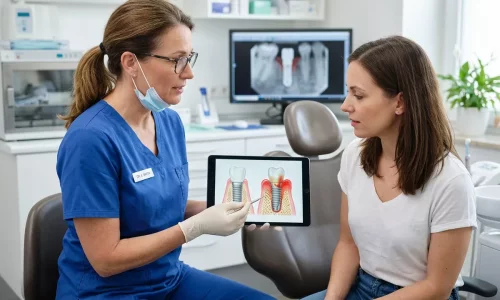
Unhappy with your existing dental implants or the restorations placed on them? Learn the common reasons for implant failure (peri-implantitis, aesthetic issues) and how revision surgery, prosthetics replacement, and careful planning can lead to satisfactory, long-term results.
Which celebrities used Invisalign? Learn how you can achieve a "red carpet" smile discreetly with clear aligners (Invisalign) and Dr. Begum Ulaşan. Get details on the treatment process and stunning aesthetic results.

Milim Dental Hospital isn't just a clinic—it's where confident smiles begin. With a team of world-class specialists, advanced technology, and a patient-first approach, we turn dental care into a premium experience.
We prioritize hygiene, comfort, and tailor-made treatments designed just for you. Don’t just take our word for it—explore real stories from real patients.
Your perfect smile starts here. Join the Milim experience.


Milim Dental Hospital provides comprehensive dental services in a spacious 1,000 m² facility, supported by a wide team of dental professionals including specialists in Oral and Maxillofacial Surgery, Prosthodontics, Orthodontics, Pediatric Dentistry, and Periodontology.