If you are thinking about orthodontic treatment with braces or clear aligners like Invisalign, one question almost always comes up:
“How do my teeth actually move inside the bone?”
It sounds almost unbelievable that solid teeth, held in bone, can slowly slide into a new, straighter position. In this guide, orthodontist in Bursa, Dr. Begüm Ulaşan, explains the biology of tooth movement in a way that patients, parents and teenagers can clearly understand.
We will look at what happens around the roots, how orthodontics uses gentle forces, why treatment takes time, and what you should expect to feel during the process.
Most people first think of orthodontic treatment as “straightening crooked teeth.” That is true, but it’s only part of the story.
An experienced orthodontist like Dr. Begüm Ulaşan plans treatment with several goals in mind:
Correct the bite (occlusion)
So upper and lower teeth fit together in a stable, functional way.
Balance the jaw relationship
Improve how the upper and lower jaws meet, which can also help jaw joints and muscles.
Improve smile aesthetics
Align teeth, shapes and smile arc so that your smile looks natural and harmonious with your face.
Support oral health and function
Well-aligned teeth are easier to clean, less prone to abnormal wear, and can help you chew and speak more comfortably.
So, orthodontics is not only about having a beautiful smile. It is also about long-term oral health, comfort and function.
To understand how teeth move, we first need to understand how they are held in place.
The white crown you see in your mouth is only one part of the tooth. Below the gum, each tooth has one or more roots that extend into the jawbone.
You can imagine:
The tooth root like a tree root,
And the jawbone like the soil around it.
But there is a very important difference: the tooth is not fused directly to the bone.
Around each root is a thin layer of soft tissue called the periodontal ligament (PDL).
This ligament:
Connects the root surface to the surrounding bone,
Acts like a shock absorber when you bite,
Contains tiny fibers, cells and blood vessels.
You can think of the PDL as a microscopic hammock or suspension system that holds the tooth in place while allowing extremely small movements.
The alveolar bone is the specific part of the jawbone that forms the socket around your teeth.
It is living bone, constantly remodeling,
It can be resorbed (broken down) and formed (built up) in response to forces.
This combination of root + PDL + alveolar bone is exactly what allows tooth movement during orthodontic treatment.
Braces treatment and clear aligners work by applying gentle, controlled forces on the teeth.
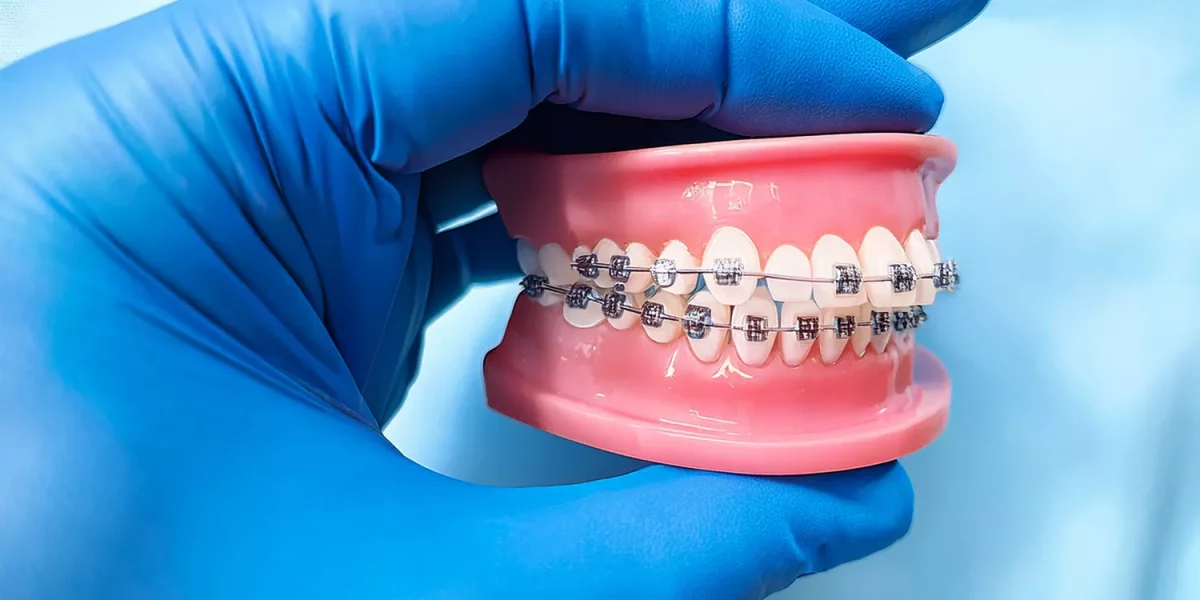
With fixed braces, the brackets are bonded to the teeth and connected with archwires.
With clear aligners (including systems like Invisalign), each aligner tray is slightly different and pushes teeth towards the next step.
Although the technology is different, the principle is the same:
a light, continuous force causes changes in the PDL and bone around the tooth root.
When a tooth is pushed in one direction:
On one side of the root, the PDL is compressed → this is the pressure side.
On the opposite side, the PDL is stretched → this is the tension side.
Your body responds to this in a very clever way:
On the pressure side, special cells start to break down bone to make space for the tooth root.
On the tension side, other cells start to build new bone behind the moving root.
This is called bone remodeling. It is a natural, healthy process that happens slowly over time. That is how orthodontic treatment moves teeth: not by “pushing them through the bone” like a nail, but by guiding a biological reshaping of the bone around them.
Many patients ask:
“If braces can move teeth, why can’t everything be straight in a few days?”
The reason is simple: biology needs time.
Bone is not a static material. Inside the alveolar bone are cells that:
Resorb bone (remove it) where space is needed,
Form new bone where support is needed.
These processes happen at the microscopic level and take days, weeks and months, not hours. If we try to move teeth too fast with very strong forces:
The PDL can be damaged,
The bone doesn’t have time to remodel properly,
The risk of root resorption and other problems increases,
Pain and discomfort can be much higher.
Modern orthodontics aims to use light, continuous forces rather than heavy, short bursts of force. This approach:
Respects the biology of the PDL and bone,
Is more comfortable for the patient,
Is safer for the roots and supporting tissues,
Gives more predictable, stable tooth movement.
So when your orthodontist in Bursa, Dr. Begüm Ulaşan, adjusts your braces or gives you a new set of clear aligners, the plan is always based on what your tissues can safely handle over time – not on how fast we would like the teeth to move.
Another common question is:
“Do braces and clear aligners move teeth in different ways?”
The short answer: they use the same biology, but different tools.
With fixed braces treatment:
Brackets are bonded to each tooth.
A flexible archwire connects the brackets.
When the wire is engaged, it wants to return to its original shape.
As it does, it puts gentle forces on the teeth, guiding them into new positions.
Additional components (like elastics or springs) can fine-tune the forces and directions of tooth movement.
With clear aligners such as Invisalign:
Your orthodontist designs the final desired position of your teeth digitally.
A series of aligners is produced, each one slightly closer to the final position.
You wear each aligner for a prescribed time (for example, 1–2 weeks).
Every time you change to a new aligner, it applies gentle pressure to move the teeth a small step.
The biology is the same: PDL compression and tension, followed by bone remodeling. The difference is mainly:
The delivery system (brackets and wires vs. plastic trays),
The look and feel (fixed vs. removable, metal vs. transparent),
The patient experience (eating, cleaning, speech, lifestyle).
In her practice in Bursa, Dr. Begüm Ulaşan offers both braces and clear aligners, choosing the most suitable option based on:
Your age and oral condition,
The complexity of your case,
Your lifestyle and aesthetic preferences,
How responsible you can be with wearing removable aligners.
Many patients worry about pain. It helps to know what is normal.
When your braces are adjusted or you switch to a new aligner, you may feel:
A feeling of tightness or pressure on some teeth,
Mild to moderate soreness when biting,
Slight discomfort for the first few days.
This is usually most noticeable:
In the first 24–72 hours after an adjustment or new aligner,
When chewing harder foods.
This soreness is a sign that the tissues around your teeth are responding to the orthodontic forces and that tooth movement is happening.
Dr. Begüm Ulaşan often recommends:
Eating softer foods for the first few days (soups, yogurt, pasta, bananas),
Chewing more slowly and carefully,
Using over-the-counter pain relief if needed (according to your medical history and doctor’s advice),
Using orthodontic wax if brackets irritate your cheeks or lips.
You should call your orthodontist if:
Pain is severe and does not improve after a few days,
You feel something sharp, broken or loose (wire, bracket, aligner),
You notice unusual swelling or signs of infection.
A well-planned orthodontic treatment supervised by a specialist like Dr. Begüm Ulaşan should cause manageable, temporary discomfort, not severe ongoing pain.
While your teeth are moving, oral hygiene becomes even more important.
If plaque and bacteria accumulate around brackets, wires or aligners:
Gums can become inflamed and bleed,
Cavities can develop around brackets,
Bad breath and staining can increase,
The bone and gums that support your teeth can be harmed.
Inflamed gums and poor hygiene can also slow down orthodontic progress and affect the final result.
During orthodontic treatment, Dr. Begüm Ulaşan typically recommends:
Brushing at least twice a day, ideally after every meal,
Using an orthodontic toothbrush or electric brush,
Cleaning carefully around brackets and along the gumline,
Using interdental brushes to clean between teeth and under the wire,
Flossing (with special floss threaders or superfloss if you wear braces),
Rinsing with a fluoride mouthwash if advised.
For clear aligners:
Brush teeth after meals before reinserting aligners,
Rinse and clean aligners as instructed (not with hot water),
Avoid sugary drinks while aligners are in.
Regular professional cleanings are also essential to keep the gums and alveolar bone healthy while tooth movement is taking place.
Parents often ask:
“Is it better to treat my child early?”
“Will my teeth move more slowly because I’m an adult?”
In growing patients:
The jaws and facial bones are still developing,
The bone can be more adaptive,
Certain problems (like jaw discrepancies) can be guided or corrected more easily.
This is why orthodontists often recommend a first evaluation around age 7–8. Early orthodontics does not always mean early braces, but it allows Dr. Begüm Ulaşan to time treatment optimally.
Adult teeth also move very well, but:
Bone remodeling can be slightly slower,
There may be more issues like gum recession, bone loss or restorations to consider,
Treatment planning may need to be more detailed and sometimes include cooperation with other dental specialists.
The good news is:
You are almost never “too old” for orthodontic treatment. With careful planning and healthy gums and bone, adults can achieve excellent results with both braces treatment and clear aligners.
Teeth move because of a controlled biological response in the periodontal ligament (PDL) and surrounding bone.
The orthodontic appliance (braces or clear aligners) applies gentle, continuous force.
This force compresses the PDL on one side of the root and stretches it on the other.
The body responds by removing bone where pressure is higher and forming new bone where the ligament is stretched.
As this remodeling continues, the tooth slowly shifts into its new position.
So, tooth movement is not a mechanical “pushing through bone,” but a guided remodeling of living tissues.
With modern orthodontic treatment planned by a specialist, the risk of serious root damage is low. However:
Some root resorption (shortening) can occur in a small percentage of patients.
This is usually mild and does not affect tooth function or long-term health.
To minimize risk:
Forces are kept light and controlled,
Treatment is monitored with regular check-ups,
X-rays are taken when needed to observe root and bone changes.
Your orthodontist in Bursa, Dr. Begüm Ulaşan, will always balance tooth movement with the safety of roots and bone.
Soreness is usually due to:
The PDL reacting to new forces,
Inflammation and increased pressure in the tissues around the tooth roots.
This is a normal part of tooth movement and often:
Peaks in the first 1–3 days,
Then gradually improves.
Soft foods, careful chewing and, when necessary, suitable pain medication can help. If pain is severe or does not improve, you should contact your orthodontist.
Teeth always have a natural tendency to relapse (move slightly back towards their original positions). This is why retention is so important.
After active orthodontic treatment:
You will receive retainers (fixed, removable or both),
These help stabilize the new positions while the bone and gums adapt,
Wearing retainers as instructed by Dr. Begüm Ulaşan is crucial for a long-lasting result.
If you do not wear your retainer, your teeth are more likely to shift again.
When done properly under the supervision of a specialist, orthodontics does not weaken healthy bone or teeth.
Bone around the teeth is remodeled, not permanently destroyed.
New bone forms behind the moving tooth root, providing ongoing support.
As long as oral hygiene is good and your gums are healthy, tooth and bone health can remain excellent.
Problems like decay, gum disease or severe root resorption are usually related to poor hygiene, uncontrolled forces or pre-existing conditions, not to well-planned braces treatment or aligners.
Yes, absolutely.
Plaque control is more challenging during orthodontic treatment.
Regular professional cleanings allow your dental team to remove tartar, monitor gum health and catch problems early.
This protects the bone and tissues that are actively involved in tooth movement.
Skipping cleanings during treatment can increase the risk of cavities, staining and gum disease.
Understanding how teeth move helps many patients feel calmer and more confident about starting orthodontic treatment.
Key points to remember:
Teeth move because the PDL and bone are living tissues that can remodel under gentle, controlled forces.
Braces and clear aligners use different tools, but the same biology of tooth movement.
Light, continuous forces are safer and more effective than strong, fast forces.
Some soreness is normal, but severe or prolonged pain is not – always inform your orthodontist.
Good oral hygiene and regular cleanings are essential to protect gums and bone during treatment.
Children, teenagers and adults can all benefit from orthodontics when treatment is carefully planned.
If you are considering braces treatment or clear aligners and still have questions about how your teeth will move, you don’t have to guess.
You can book a consultation with orthodontist in Bursa, Dr. Begüm Ulaşan, to have your teeth, jaws and smile evaluated in detail. Together, you can choose a treatment plan that is:
Biologically safe,
Aesthetically pleasing,
Comfortable for your lifestyle,
Designed to give you a healthy, confident smile for many years to come.
A guide explaining the risk of staining with ceramic brackets and tips for keeping them clean.
Discover why a well-designed smile has a powerful impact on how others perceive you.

A guide explaining the different retainers used post-braces or aligners and their purposes.
Milim Dental Hospital isn't just a clinic—it's where confident smiles begin. With a team of world-class specialists, advanced technology, and a patient-first approach, we turn dental care into a premium experience.
We prioritize hygiene, comfort, and tailor-made treatments designed just for you. Don’t just take our word for it—explore real stories from real patients.
Your perfect smile starts here. Join the Milim experience.

Milim Dental Hospital provides comprehensive dental services in a spacious 1,000 m² facility, supported by a wide team of dental professionals including specialists in Oral and Maxillofacial Surgery, Prosthodontics, Orthodontics, Pediatric Dentistry, and Periodontology.