English
Big Sale – Last Days for 20% Off!
106HOUR 42MINUTE 29SECOND
Missing Teeth and Orthodontic Braces Treatment

Missing Teeth and Orthodontic Braces Treatment

8 December Mon, 2025

Bursa Orthodontic Specialist Dr. Begüm Ulaşan Explains

Do you look in the mirror and see that one of your teeth is missing, and the gap in your smile bothers you? Or has your dentist told you, "Some of your permanent teeth are missing from birth, and your teeth have started to shift because of this"?

Missing teeth are not just an aesthetic issue. They can affect chewing, speech, the temporomandibular joint (TMJ), and even the shape of your face.

Request a Free Treatment Plan from Our Expert Doctors

At this point, patients planning orthodontic treatment, especially in Bursa, often ask the following questions:

  1. Can braces treatment be done when a tooth is missing?
  2. Can these gaps be closed with orthodontics?
  3. Does every missing tooth require an implant, or is a solution possible with braces treatment?
  4. My child's permanent teeth are missing; when and how should we consider orthodontics?

In this article, from the perspective of Bursa orthodontic specialist Dr. Begüm Ulaşan, we will discuss in detail, clearly, and in an SEO-friendly manner how treatment with missing teeth and orthodontic braces/clear aligners is planned.

1. What is a Missing Tooth? Not Every Tooth Loss is the Same

Let's start with the basic definition. When we say "missing tooth," we can refer to two different situations:

A. Congenitally Missing Teeth (Missing from Birth)

Some permanent teeth may have never formed due to genetic reasons. Especially:

  1. Premolars
  2. Lateral incisors

can be congenitally missing. This condition is called hypodontia (a few missing teeth), or oligodontia if many teeth are missing.

B. Teeth Lost Later

Teeth may have been extracted or lost spontaneously due to reasons such as:

  1. Advanced decay
  2. Trauma
  3. Gum disease (periodontitis)
  4. Failed root canal treatments

In both situations, a gap appears in the mouth. But the meaning of this gap from an orthodontic perspective changes based on your age, jaw structure, and the condition of your other teeth.

Bursa orthodontic specialist Dr. Begüm Ulaşan specifically looks at the following during the initial examination:

  1. Is the missing tooth a single tooth or multiple teeth?
  2. Is the missing tooth in the aesthetic region or the back region?
  3. What is the condition of the adjacent teeth? Is there tilting? Has crowding started?
  4. Is the jaw relationship (upper-lower jaw) balanced or disrupted?
  5. What is the age? Is growth complete?

Because missing tooth ≠ one-size-fits-all solution. A different roadmap is needed for every patient.

2. How Do Missing Teeth Affect Jaw and Dental Structure?

Thinking, "Oh, only one tooth is missing, what's the big deal?" might seem easy at first. But the mouth does not like gaps. The body starts to reorganize the teeth and jaws "on its own" to maintain balance.

2.1. Tooth Shifting and Tilting

The teeth next to the missing tooth:

  1. Tilt towards the gap over time.
  2. The opposing tooth in the other jaw elongates into the gap (over-erupts).

The Result:

  1. Chewing balance is disturbed.
  2. Food accumulation between teeth increases.
  3. Hard-to-clean areas form.
  4. The risk of decay and gum problems increases.

2.2. Crowding and Malocclusion

Missing teeth:

  1. If in the side area, chewing shifts more to the other side.
  2. If in the aesthetic region, the "gap" in the smile is demoralizing.
  3. As the teeth take new positions among themselves, the bite relationship deteriorates.

In the long term:

  1. The jaw joint may be stressed.
  2. Muscle pain, headaches, and aesthetic/functional difficulties may increase.

For this reason, the trio of Orthodontics – Bursa – Missing Teeth must be evaluated together, especially in adult patients and growing adolescents.

3. Missing Teeth and Orthodontics: Core Strategies

A tooth is missing, and we are considering braces treatment. What does orthodontics do with these gaps?

Generally, there are three approaches:

  1. Closing the gap orthodontically.
  2. Maintaining the gap and preparing the area for an implant/prosthesis.
  3. Using a combination of these.

3.1. Closing the Gap Orthodontically

In some cases:

  1. If the jaw relationship and tooth alignment are favorable in the region of the missing tooth.
  2. Especially if the missing tooth is in the posterior region.
  3. It is possible to close the gap by carefully sliding the neighboring teeth.

Advantages:

  1. An implant/prosthesis may not be needed in the future.
  2. Function and aesthetics are provided with existing teeth.
  3. The need for "an extra artificial restoration" decreases.

Disadvantages:

  1. More comprehensive orthodontic planning is needed to balance the bite in some situations.
  2. When moving a premolar to an incisor position in the aesthetic region, smile design must be done well.

Dr. Begüm Ulaşan in Bursa often evaluates the option of closing the gap with orthodontics, especially in young patients with congenitally missing premolars or small molars. This way, both the tooth alignment is corrected, and the need for an implant in the future may be eliminated.

3.2. Maintaining the Gap and Preparing for an Implant/Prosthesis

In some situations:

  1. For missing teeth in the aesthetic region (especially upper lateral incisors).
  2. In terms of facial and lip support and the smile line.
  3. It is more appropriate to prepare the area for an ideal implant/prosthesis rather than closing the gap.

In this scenario, the role of orthodontics is:

  1. To maintain the gap at the correct width.
  2. To bring the adjacent teeth to the appropriate angles.
  3. To make the area where the implant will be placed as close to three-dimensionally ideal as possible.

Advantages:

  1. A very natural and symmetrical smile can be achieved, especially with upper lateral incisor deficiencies.
  2. The size and form of the teeth are very well controlled aesthetically.

Disadvantages:

  1. An additional prosthetic treatment, such as an implant or bridge, is needed in the future.
  2. Planning must be done jointly by the orthodontist + prosthodontist + implant surgeon.

Bursa orthodontic specialist Dr. Begüm Ulaşan often prefers a multidisciplinary approach in such cases, working together with the orthodontist and the implant-prosthesis team.

The patient is informed with this clarity at the start: "If we close this gap with orthodontics, there will be these advantages/disadvantages, and if we prepare it for an implant, there will be these advantages/disadvantages." The decision is made jointly based on the patient's age, aesthetic expectations, bone density, general health status, and budget.

4. What Do Missing Teeth Mean for Orthodontics in Children and Adolescents?

Missing teeth are not only common in adults but also frequently encountered in families seeking pediatric orthodontics in Bursa.

Especially:

  1. Congenitally missing premolars
  2. Congenitally missing upper lateral incisors

when noticed early during the growth phase, offer the opportunity to plan future treatment much more controllably.

4.1. Detection of Missing Teeth in the Mixed Dentition Period (Ages 6–12)

During this period:

  1. Permanent tooth buds can be seen on panoramic X-rays.
  2. Which permanent teeth have not developed at all (are congenitally missing) can be determined.

When Dr. Begüm Ulaşan in Bursa detects a congenitally missing tooth in a child who comes for an orthodontic examination during the mixed dentition period, she plans the following:

  1. Will space maintenance be performed in the area of the missing tooth?
  2. Will the gap be closed with orthodontics, or maintained for a future implant?
  3. If there is jaw narrowness or malocclusion, when should intervention be made?

This way, when the child starts braces treatment later:

  1. Unnecessary tooth extractions can be avoided.
  2. Gaps are managed more controllably.
  3. If necessary, early expansion or functional treatments can guide jaw development in the right direction.

4.2. Orthodontic Planning in Full Adolescence (Ages 12–16)

At these ages:

  1. A large part of jaw growth is complete.
  2. Most permanent teeth have erupted.
  3. The effect of missing teeth can now be seen more clearly: severe crowding, tilting towards the gaps, and imbalance in the upper-lower jaw relationship.

Dr. Begüm Ulaşan, who plans orthodontic treatment in Bursa during this period, sits down with young patients and their families to find answers to the following questions:

  1. How will the face and smile look if the gaps are closed with orthodontics?
  2. What kind of aesthetics and function will we achieve if we maintain the gaps for a future implant/prosthesis?
  3. Knowing that an implant may be placed at an older age, what foundation should we prepare with braces treatment at this age?

Thus, the treatment is not just designed to answer the question, "How can the teeth be straight right now?" but also the question, "How should the mouth structure look 20–30 years from now?"

5. Missing Teeth and Orthodontic Braces / Clear Aligner Treatment in Adults

Adult orthodontics is now very common. In Bursa, too, many patients in their 20s, 30s, 40s, and even 50s consult Dr. Begüm Ulaşan for orthodontics.

In a significant portion of these patients:

  1. One or more previously extracted teeth.
  2. Gaps that have not been used for years.
  3. Bridges or old prostheses.
  4. Losses after gum problems can be seen.

5.1. Core Goals in Adults

The goals in the adult missing tooth – orthodontics combination are:

  1. Correcting crowded teeth.
  2. Improving smile aesthetics.
  3. Regulating chewing function.
  4. Bringing areas for implant/prosthesis placement to the ideal position.
  5. Achieving a long-term, sustainable result while preserving gum health.

5.2. Braces Treatment or Clear Aligners?

In adults with missing teeth:

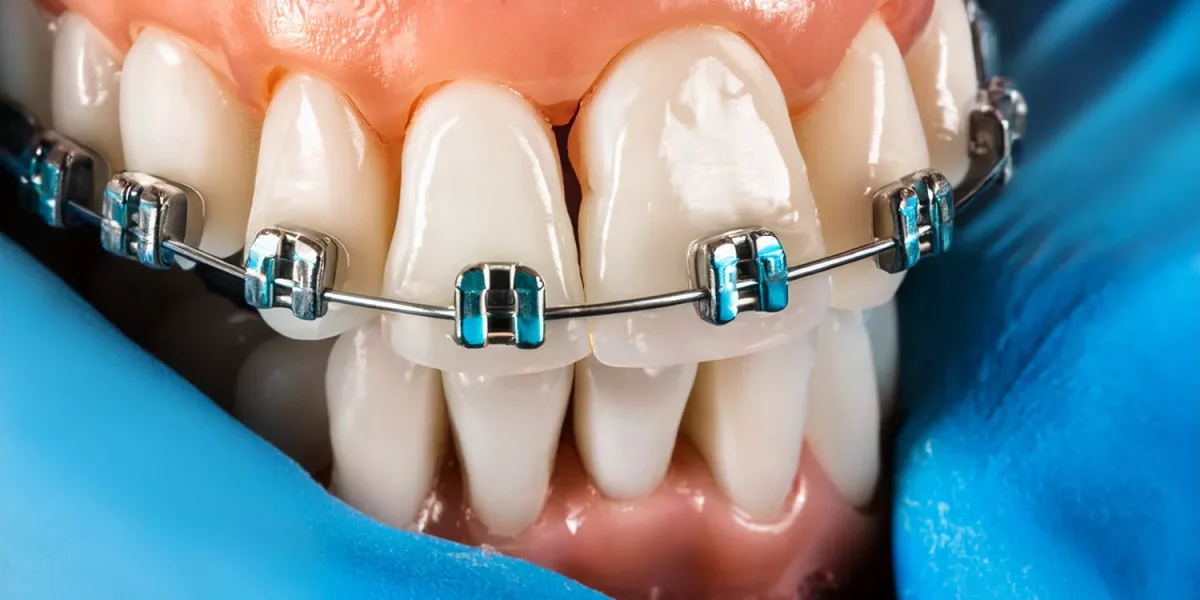
  1. Classic braces (metal/aesthetic brackets)
  2. Clear aligner systems (aligner treatments)

can be used.

Braces Treatment:

  1. High control power.
  2. Advantageous, especially in large gap closures and complicated movements.

Clear Aligner Treatment:

  1. Very advantageous aesthetically.
  2. Compatible with adult work and social life.
  3. Can also be used in many missing tooth cases (depending on case suitability).

Bursa orthodontic specialist Dr. Begüm Ulaşan, if an adult patient has missing teeth, often plans the treatment around this trio:

  1. Orthodontic adjustment of gaps and tooth positions.
  2. Preparation of areas for implant/prosthesis, if necessary.
  3. Preservation of the result with retention after treatment.

6. Frequently Asked Questions

"Can I get braces if my tooth is missing?"

Yes, orthodontic braces treatment can easily be performed with a missing tooth. In fact, most of the time, the goal of braces treatment is to correctly shape the area of the missing tooth—either to close the gap or to make it suitable for an implant/prosthesis.

"I have congenitally missing teeth; is braces treatment alone enough?"

This depends on where the tooth is missing:

  1. For a missing premolar in the posterior region, it may be possible to close the gap with orthodontics in most cases.
  2. For a missing tooth in the aesthetic region, such as an upper lateral incisor, sometimes the best solution is to bring the teeth to the ideal position with orthodontics and maintain that area for an implant or an aesthetic veneer.

The best approach is to be examined by an orthodontist like Dr. Begüm Ulaşan in Bursa and listen to the plan customized for you.

"Should I get an implant first for my missing teeth, or should I get braces first?"

A very critical question. The generally recommended sequence is: Orthodontics first, then implant/prosthesis.

Because:

  1. As the teeth and gaps are reorganized with orthodontics, the area and angle where the implant will be placed are also shaped.
  2. Once the implant is placed, it is a fixed structure fused to the bone, and it becomes difficult to perform major orthodontic movements around it.

Therefore, when planning in Bursa:

  1. The orthodontist first designs the bone and tooth alignment.
  2. Then, the most appropriate timing is determined jointly with the implant/prosthesis dentist.

7. Conclusion: If You Have Missing Teeth, Orthodontics is Often Not a "Luxury" But a "Fundamental Plan"

Let's summarize:

  1. Missing teeth can lead to tooth shifting, tilting, and chewing/bite disorders.
  2. This is not just an aesthetic problem but a functional and long-term health issue.
  3. Orthodontics (braces or clear aligners) in cases with missing teeth can:
  4. Close the gaps.
  5. Prepare the ideal foundation for an implant/prosthesis.
  6. Correct crowding.
  7. Re-establish jaw balance.

If you are thinking:

  1. "I have a missing tooth, can I get braces?"
  2. "Should we close the gap or get an implant?"
  3. "My child has some congenitally missing permanent teeth; when should we take them to the orthodontist?"

especially if you live in or around Bursa, planning an examination with orthodontic specialist Dr. Begüm Ulaşan will be the best start for you.

Remember: With correctly planned orthodontic treatment, missing teeth can cease to be just "a lack to be compensated for" and become the first step toward a healthy, balanced, and aesthetic smile.


Category: Orthodontics

A Milim
Makes a Big Difference

Milim Dental Hospital is the first dental centre to receive the "Health Tourism Authorisation Certificate" issued by the Ministry of Health of the Republic of Turkey.
All Articles
Full Mouth Dental Packages in Turkey: Affordable Luxury Dental Tourism in Bursa
east

When it comes to full mouth restoration, patients worldwide are increasingly turning to one solution: Dent in Turkey. With world-class care, advanced implant technologies, and significant cost savings, Turkey has earned its place as a global hub for dental tourism. But while most eyes are on Istanbul or Antalya, there’s a rising star that offers unmatched peace, quality, and value: Bursa.

How Orthodontic Treatment Works
east

Orthodontics is a branch of dentistry that focuses on diagnosing and treating structural irregularities in the teeth, jaw, and facial area. Orthodontic treatment helps guide the dental and jaw development of children, ensuring proper tooth eruption. In adults, it corrects existing structural problems such as jaw misalignment, bite issues, and gaps between teeth.

Can My Jaw Structure Be Corrected with Orthodontics, or Is Surgery Necessary?
east

Can braces or Invisalign fix severe jaw misalignment (Class II/III)? Orthodontic Specialist Dr. Begüm Ulaşan in Bursa explains when orthodontics alone is enough and when Orthognathic Surgery is required for true skeletal correction. Get a personalized analysis.

Why Patients
Choose Milim?

Milim Dental Hospital isn't just a clinic—it's where confident smiles begin. With a team of world-class specialists, advanced technology, and a patient-first approach, we turn dental care into a premium experience.
We prioritize hygiene, comfort, and tailor-made treatments designed just for you. Don’t just take our word for it—explore real stories from real patients.
Your perfect smile starts here. Join the Milim experience.
View All Experiences
play_arrow
Dt. İsmail Özkısaoğlu Dentist
Get a Free Consultation
play_arrow
Dr. Dt. Ali Direnç Ulaşan Oral, Dental, Maxillofacial Surgeon
Get a Free Consultation
play_arrow
Dr. Dt. Ali Direnç Ulaşan Oral, Dental, Maxillofacial Surgeon
Get a Free Consultation

Milim Dental Hospital provides comprehensive dental services in a spacious 1,000 m² facility, supported by a wide team of dental professionals including specialists in Oral and Maxillofacial Surgery, Prosthodontics, Orthodontics, Pediatric Dentistry, and Periodontology.

Our clinic is authorized by the Turkish Ministry of Health for International Health Tourism. This website is intended only for informing patients from abroad. It does not contain advertisements and complies with legal privacy regulations.
Milim Dental Hospital © 2025 - All rights reserved.

Have a Question on Your Mind?

At Milim Dental Hospital, we accept a maximum of 10 international patients per month. This allows us to provide each patient with personalized care and the highest quality of treatment. Let us know how we can help you!

Would you like to see real patient results? Feel free to explore our Case Gallery!

English
Big Sale – Last Days for 20% Off!