English
Big Sale – Last Days for 20% Off!
492HOUR 18MINUTE 50SECOND
Who is an Orthodontist?

Who is an Orthodontist?

8 December Mon, 2025

Who is an Orthodontist?

If you are looking for the answer to the question, Who is an orthodontist?, you probably also have these questions in mind:

  1. “Who provides braces treatment?”
  2. “Who handles clear aligners like Align and Invisalign?”
  3. “Is an orthodontist the same person as a general dentist?”
  4. “What does an orthodontist do in clinics like Milim Dental and Dr. Begüm Ulaşan’s in Bursa?”

In the comprehensive article below, we will explain exactly who an orthodontist is, what they do, which treatments they apply, and cover topics like braces versus Invisalign, and pediatric versus adult orthodontics. We will ensure the text is SEO-friendly by frequently including the terms orthodontist, braces, Align, Invisalign, clear aligner, Dr. Begüm Ulaşan, and Milim Dental.

Request a Free Treatment Plan from Our Expert Doctors

WHO IS AN ORTHODONTIST?

In the simplest definition:

An orthodontist is a dentist who has completed specialized training in the diagnosis and treatment of problems affecting the alignment of the teeth, jaws, and temporomandibular joint (TMJ).

In other words, every orthodontist is a dentist, but not every dentist is an orthodontist.

An orthodontist:

  1. Corrects conditions where teeth are crooked, crowded, spaced, or packed too tightly.
  2. Treats conditions where the upper and lower jaws do not close correctly (malocclusion/bad bite).
  3. Evaluates jaw relationships, facial profile, and smile aesthetics together.
  4. Works using braces, clear aligners like Align/Invisalign, or in collaboration with orthognathic surgery when necessary.

In Bursa, orthodontist Dr. Begüm Ulaşan is exactly this kind of specialist, with intensive experience in braces, clear aligners (aligner), Invisalign, and smile design.

HOW DOES ONE BECOME AN ORTHODONTIST?

To fully answer the question, "Who is an orthodontist?", it's essential to understand the process of becoming an orthodontist.

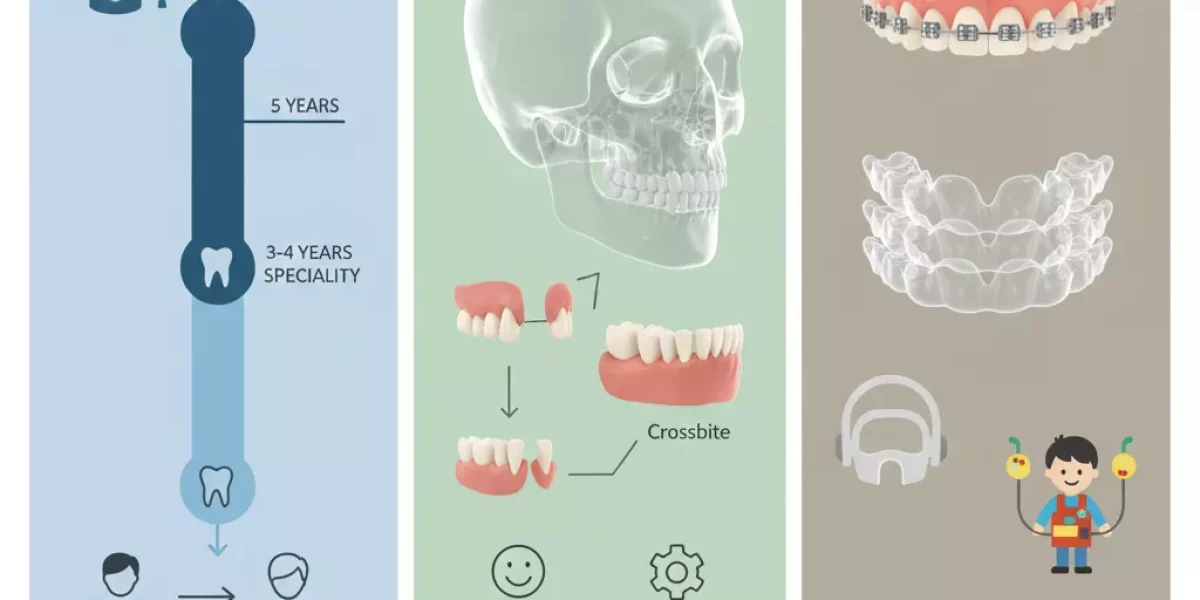
  1. First, a 5-year dental school education is completed.
  2. The individual then gains acceptance into an orthodontics specialization program through national exams (like TUS/DUS or relevant equivalents).
  3. They receive an additional 3–4 years of intensive theoretical and clinical training exclusively in orthodontics.
  4. The dentist who successfully completes this training earns the title of Orthodontist (Orthodontic Specialist).

This means an orthodontist is a person who has completed at least 3–4 years of additional training focused only on orthodontic treatments after dental school.

Therefore:

  1. Reading articles online about "putting on braces,"
  2. Attending short courses,

does not make a dentist an orthodontist.

The orthodontist's perspective is crucial, especially in planning clear aligner systems like Align and Invisalign. Even though the aligner is modern and comfortable, the orthodontist still manages the treatment intelligence.

WHAT DOES AN ORTHODONTIST DO?

The scope of an orthodontist's work is not limited only to the wires placed on teeth.

An orthodontic specialist:

  1. Evaluates the position of the teeth (rotated, forward, backward, impacted).
  2. Analyzes the relationship between the upper and lower jaws (Class I, Class II, Class III, open bite, deep bite, etc.).
  3. Examines the facial profile (lower facial height, chin position, lip position).
  4. Checks whether the bite is compatible with the temporomandibular joint (TMJ) and chewing muscles.
  5. Creates different orthodontic treatment plans for different stages in children, adolescents, and adult patients.

The primary treatment tools they use include:

  1. Braces (Bracket) Treatments:
  2. Metal brackets
  3. Aesthetic (clear/ceramic) brackets
  4. Lingual (placed on the inside) bracket systems
  5. Clear Aligner Treatments:
  6. Brands like Align, Invisalign
  7. Pre-designed systems or custom aligners planned under the orthodontist's supervision.
  8. Functional Appliances (devices that guide jaw development, especially in growing children).

In Bursa, Dr. Begüm Ulaşan, an orthodontist working under the roof of Milim Dental, plans all these treatment options using personalized combinations based on the patient's age, dental structure, profession, and aesthetic expectations.

WHAT ARE BRACES, AND WHAT DOES THE ORTHODONTIST DO IN THIS TREATMENT?

Braces are the most recognized and classic method of orthodontic treatment.

In braces treatment:

  1. Small brackets are bonded onto the teeth.
  2. Wires (archwires) passed through these brackets move the teeth to the desired position with light forces.
  3. The orthodontist manages the treatment by adjusting these wires and elastics at every check-up.

In braces treatment, the orthodontic specialist:

  1. Details which teeth will move in which direction.
  2. Plans the approximate result and duration.
  3. Decides whether treatment will be extraction or non-extraction.
  4. Determines which archwires will be used in the upper and lower jaws.
  5. Plans which appliances will be added if there is a jaw issue.

Braces treatment can be successfully applied in:

  1. Children
  2. Adolescents
  3. Adults (even patients over 30, 40, or 50 years old).

In Bursa, Dr. Begüm Ulaşan at Milim Dental plans braces treatment not only to "straighten crooked teeth" but also by considering the TMJ and chewing function.

ALIGN, INVISALIGN, AND CLEAR ALIGNER TREATMENTS

In recent years, another concept is heard as often as braces when talking about orthodontics: Clear Aligner Treatment.

In this treatment:

  1. Your teeth are scanned in 3D using intraoral scanners (digital impressions).
  2. The precise positions your teeth will take throughout the treatment are planned in a computer environment.
  3. A series of clear aligners (each representing small steps) are manufactured.
  4. You wear these aligners for 20–22 hours a day and change them every few weeks.

One of the most well-known brands of these systems is Invisalign. It is a system produced by Align Technology, used by millions of people worldwide, and supported by robust data infrastructure.

The critical point here is:

The success of Invisalign or any Align system depends less on the brand that produces the aligners, and more on the experience of the orthodontist who plans the treatment.

In Bursa, orthodontist Dr. Begüm Ulaşan at Milim Dental applies Invisalign and other aligner systems as clear aligner treatment for:

  1. Adult patients who do not want to wear braces.
  2. Individuals with high aesthetic concerns in professions like presentation, acting, performing, or teaching.
  3. Mild and moderate crowding cases.
  4. Some pediatric and adolescent cases (in appropriately selected instances).

In this approach:

  1. Both braces and clear aligner (Align / Invisalign) options are explained in detail during the initial examination.
  2. The two systems are objectively described to the patient in terms of duration, cost, comfort, aesthetics, and impact on daily life.
  3. The orthodontist selects the most appropriate path together with the patient.

WHAT IS THE DIFFERENCE BETWEEN AN ORTHODONTIST AND A GENERAL DENTIST?

Some patients ask this question:

"My dentist also places braces; do I need to see an orthodontist?"

The critical point here is:

  1. A general dentist has fundamental training in many areas like extractions, fillings, root canals, and prosthetics.
  2. Orthodontics, however, is a separate specialty.

An orthodontist plans the long-term function and aesthetics together by thinking about jaw and tooth relationships in three dimensions.

It is very important to work with an orthodontist for the long-term success of treatment, especially in more complex cases such as:

  1. Jaw constriction.
  2. Lower jaw positioned too far forward or backward.
  3. Asymmetries.
  4. Malocclusions (open bite, deep bite).
  5. Cases in children requiring growth guidance.

Milim Dental in Bursa has a structure that clearly observes this distinction:

  1. General dentistry procedures are performed by the relevant dentists.
  2. Planning and treatments related to orthodontics are performed by the orthodontic specialist Dr. Begüm Ulaşan.

WHEN SHOULD I SEE AN ORTHODONTIST?

You should see an orthodontist if you are experiencing any of the following:

  1. Your teeth are crooked, crowded, or overlapping.
  2. There are gaps (spaces) between your front teeth.
  3. Your lower teeth are positioned too far behind or too far ahead of your upper teeth.
  4. You notice a shift in your jaw forward, backward, or sideways.
  5. The appearance of your teeth when you smile bothers you.
  6. Your child's upper front teeth are very prominent, or the lower jaw appears noticeably forward/backward.
  7. Your child sleeps with their mouth open, constantly breathes through their mouth, or struggles to close their lips.
  8. You clench your teeth and wake up with jaw fatigue in the morning.

For such complaints, consulting with Dr. Begüm Ulaşan at a center in Bursa like Milim Dental that combines orthodontics and oral surgery will provide you with a clear roadmap for both braces and Invisalign / Align treatment.

PEDIATRIC AND ADULT ORTHODONTICS: DOES AN ORTHODONTIST TREAT ALL AGES?

There used to be a perception that "braces are only for children."

Today, orthodontists know that:

  1. Some jaw irregularities in childhood can be corrected by guiding growth.
  2. There is more freedom of movement on both the teeth and jaw development during adolescence.
  3. Successful results can be achieved even in adulthood (ages 30, 40, 50, and above) with braces or Invisalign aligner treatments.

The orthodontist uses different strategies based on age:

  1. Children aged 7–10:
  2. Jaw constrictions.
  3. Habits like thumb sucking and mouth breathing.
  4. Eruption direction of permanent teeth.
  5. Are evaluated. Protective/preventive treatments are planned if necessary.
  6. Adolescence:
  7. Comprehensive orthodontic treatments are performed with braces.
  8. Jaw development is guided with functional appliances if necessary.
  9. Adults:
  10. Aesthetic concerns may be prioritized.
  11. Braces or clear aligner (Invisalign, Align, aligner) options are offered.
  12. Orthognathic treatments combined with jaw surgery may be considered.

In Bursa, Dr. Begüm Ulaşan at Milim Dental offers an orthodontic approach that caters to both children and adult patients; they manage complex cases by collaborating with oral surgeons located in the same clinic when necessary.

FREQUENTLY ASKED QUESTIONS ABOUT ORTHODONTISTS

QuestionAnswer
Who is an orthodontist?A dentist who has specialized in the diagnosis and treatment of problems affecting the alignment of the teeth and jaws, having completed an additional 3–4 years of specialized training in orthodontics after dental school.
What is the difference between an orthodontist and a general dentist?Both are dentists; however, an orthodontist is formally specialized in and exclusively focuses on orthodontic treatments and jaw relationships.
Who provides braces treatment?Braces treatment should ideally be planned and managed by an orthodontist. This is because it requires correct planning not just for straightening teeth, but also for jaw and joint relationships.
Is it necessary to see an orthodontist for Invisalign and other Align clear aligners?Yes. Regardless of how good the system that produces the aligners is, the orthodontist decides how the teeth will move, which teeth will be shifted in what order, how many aligners will be needed, and how far the treatment will proceed.
Who provides orthodontic treatment at Milim Dental?Orthodontic treatments within Milim Dental in Bursa are conducted by the orthodontic specialist Dr. Begüm Ulaşan. Both braces and clear aligner (Invisalign, aligner) options are planned here.
I'm an adult; is it too late for braces?No. Adult orthodontics is very common today. If your tooth, bone, and gum health are suitable, you can straighten your teeth with braces or clear aligner treatments even in your 30s, 40s, or 50s.

CONCLUSION: THE ORTHODONTIST IS THE SPECIALIST WHO PLANS YOUR SMILE

In summary:

  1. An orthodontist is a dental specialist who evaluates all conditions disrupting tooth and jaw alignment from a scientific and aesthetic perspective, and who personally plans treatments like braces and clear aligners such as Align / Invisalign.
  2. While any dentist might appear to use orthodontic agents, working with a true orthodontic specialist is crucial for comprehensive and lasting treatment.
  3. Terms like braces, Invisalign, Align, and clear aligner are merely tools; the person who plans when, how, and for how long these tools will be used is the orthodontist.
  4. Dr. Begüm Ulaşan, an orthodontist working within Milim Dental in Bursa, bases her practice on this approach, offering modern, comfortable, and aesthetic solutions to her patients—both children and adults—using both braces and clear aligner treatments.

If you are thinking, "Who is an orthodontist, and are braces or clear aligners like Invisalign better for me?" the first step is to get an orthodontic examination.

A healthy and aesthetic smile is possible for you too, with correct information, correct planning, and the correct specialist.


Category: Orthodontics

A Milim
Makes a Big Difference

Milim Dental Hospital is the first dental centre to receive the "Health Tourism Authorisation Certificate" issued by the Ministry of Health of the Republic of Turkey.
All Articles
The Hollywood Smile Makeover Process: What to Expect
east

Achieving a Hollywood Smile involves personalized cosmetic treatments, including teeth whitening, veneers, bonding, and possibly crowns or implants. The process ensures a stunning, symmetrical smile tailored to your needs, boosting your appearance and confidence over several visits.

Can You Get Braces After 30?
east

“Now that I’m over 30, is it too late for braces?” This is one of the most common questions adult patients in Bursa and Nilüfer ask during their orthodontic consultation. Short answer: No, you’re not too late.

Are Veneers Right for You? How to Determine If You’re a Candidate
east

Dental veneers can transform your smile, but they may not be for everyone. If you're considering veneers, it’s essential to know if you’re a good candidate. Learn about the ideal candidates, oral health requirements, and considerations to decide if veneers are right for you.

Why Patients
Choose Milim?

Milim Dental Hospital isn't just a clinic—it's where confident smiles begin. With a team of world-class specialists, advanced technology, and a patient-first approach, we turn dental care into a premium experience.
We prioritize hygiene, comfort, and tailor-made treatments designed just for you. Don’t just take our word for it—explore real stories from real patients.
Your perfect smile starts here. Join the Milim experience.
View All Experiences
play_arrow
Dt. İsmail Özkısaoğlu Dentist
Get a Free Consultation
play_arrow
Dr. Dt. Ali Direnç Ulaşan Oral, Dental, Maxillofacial Surgeon
Get a Free Consultation
play_arrow
Dr. Dt. Ali Direnç Ulaşan Oral, Dental, Maxillofacial Surgeon
Get a Free Consultation

Milim Dental Hospital provides comprehensive dental services in a spacious 1,000 m² facility, supported by a wide team of dental professionals including specialists in Oral and Maxillofacial Surgery, Prosthodontics, Orthodontics, Pediatric Dentistry, and Periodontology.

Our clinic is authorized by the Turkish Ministry of Health for International Health Tourism. This website is intended only for informing patients from abroad. It does not contain advertisements and complies with legal privacy regulations.
Milim Dental Hospital © 2025 - All rights reserved.

Have a Question on Your Mind?

At Milim Dental Hospital, we accept a maximum of 10 international patients per month. This allows us to provide each patient with personalized care and the highest quality of treatment. Let us know how we can help you!

Would you like to see real patient results? Feel free to explore our Case Gallery!

English
Big Sale – Last Days for 20% Off!