
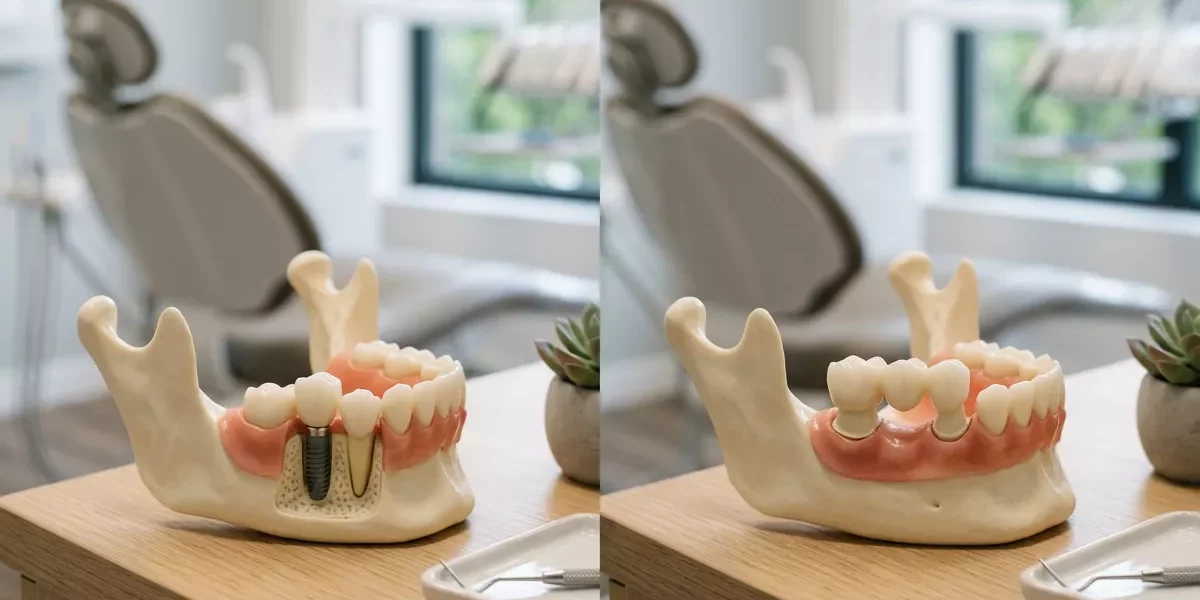
One of the most common questions patients ask after losing a tooth is this: should I get a dental implant or a bridge? It sounds like a simple comparison, but for most people it is not really a question about two products. It is a question about comfort, long-term value, daily function, and whether the treatment fits the actual condition of the mouth.
Patients often come into this discussion with strong assumptions. Some think implants are always better because they sound more advanced. Others believe bridges are easier and faster, so they must be the more practical choice. In reality, both treatments can be very successful when they are chosen for the right reason. The important thing is not which option sounds more modern. The important thing is which option is more suitable for the patient’s teeth, gums, bone, and long-term goals.
This is why the comparison matters so much. A missing tooth is not only a cosmetic issue. It can affect chewing, neighboring teeth, bite balance, and confidence. Choosing the wrong replacement may create frustration later, even if it seems simpler at the beginning. Choosing the right one can make daily life feel much more natural and stable.
At Milim Dental, this decision is explained carefully because the best treatment is not the most popular one. It is the one that fits the patient’s mouth and future in the most realistic way.
**What is the main difference between an implant and a bridge?**
A dental implant replaces a missing tooth by placing an artificial root into the jawbone and then restoring it with a crown. A bridge replaces the missing tooth by using the teeth next to the gap as support. From the patient’s point of view, both options fill the space. Clinically, however, they work in very different ways.
This difference matters because a bridge depends on neighboring teeth, while an implant usually stands more independently. If the teeth next to the gap are healthy, some patients prefer not to involve them in treatment. If those teeth already need crowns or already have large restorations, a bridge may be more reasonable than patients first assume.
The key point is that one treatment preserves independence in the missing space, while the other shares the work with surrounding teeth. Neither approach is automatically wrong. But they are not interchangeable in a biological sense, and that is why the decision should be made with proper evaluation rather than guesswork.
At Milim Dental, patients are guided through this distinction so the decision feels logical, not confusing.
**When may an implant be the better option?**
A dental implant may be the better option when the gap has enough bone support, the gums are healthy enough to support the site, and the neighboring teeth are in good condition. In these cases, replacing only the missing tooth without using the adjacent teeth can feel like a very attractive and conservative long-term plan.
Many patients prefer implants because they like the idea of a stand-alone solution. They do not want healthy teeth involved if there is no need. They also often feel that an implant-supported tooth seems more independent during chewing and more natural psychologically, especially in single-tooth cases.
Implants can also be appealing when the patient wants a fixed replacement that feels more stable over time. Of course, this does not mean implants are automatic. Bone condition, oral hygiene, bite forces, smoking, and general health all influence whether the site is really suitable.
At Milim Dental, implant treatment is recommended when the missing space can support it well and when it truly makes more sense than involving other teeth unnecessarily.
**When may a bridge still be the smarter choice?**
A bridge may still be an excellent option in certain patients. If the teeth next to the gap already need crowns, already have large fillings, or already need restorative work for their own reasons, a bridge may become a very practical and efficient solution. In such cases, it is not simply a compromise. It may actually be the more appropriate treatment.
Some patients also prefer to avoid implant surgery. Others may have bone or medical factors that make implant planning more cautious or less straightforward. In those situations, a bridge can provide a fixed solution without requiring the same kind of surgical preparation.
This is why bridges should not be dismissed as outdated. They still have a valid role in dentistry when the surrounding conditions support them. The real issue is not whether a bridge is older or newer than an implant. The real issue is whether it fits the specific case properly.
At Milim Dental, bridges are discussed honestly as real treatment options rather than second-choice solutions by default.
**What about comfort, chewing, and daily life?**
From the patient’s point of view, this part may be even more important than the technical explanation. People want to know how the treatment will feel when they eat, speak, clean their teeth, and live their normal life. In that sense, both implants and bridges can work well, but they may feel different in daily use.
An implant-supported crown usually feels more independent because it replaces the tooth directly in the space where it is missing. A bridge, by comparison, creates one joined structure supported by adjacent teeth. Some patients feel very comfortable with that. Others prefer the idea of something more separate and self-contained.
Cleaning habits are also different. A bridge often requires patients to be more aware of how they clean under or around the connected area. An implant crown still needs careful hygiene, especially around the gum line, but the patient may feel that it behaves more like a single restored tooth.
At Milim Dental, these day-to-day realities are treated as part of the decision, because a treatment is not truly successful unless it works well in daily life.
**How should patients decide?**
The best decision usually comes from asking the right questions. Are the neighboring teeth healthy? Is the bone suitable for implant placement? Is the patient comfortable with a surgical option? Would involving adjacent teeth be reasonable or unnecessary? How important is independence of the missing tooth replacement in the long term?
These questions are much more useful than simply asking which treatment is “better.” A bridge may be the best fit for one patient and a less ideal choice for another. The same is true for implants. Without proper diagnosis, comparing them is like comparing two answers before understanding the actual problem.
Patients often feel more confident once they stop looking for a universal winner and start looking for the most appropriate treatment for their own mouth. That shift makes the consultation much more meaningful.
At Milim Dental, the goal is not to sell one category over the other. The goal is to show the patient why one option may be more suitable than the other in their particular case.
**Frequently Asked Questions**
**Is a dental implant better than a bridge?**
Not automatically. A dental implant may be the better option in many patients, especially when the neighboring teeth are healthy and the site has enough bone support. However, a bridge can also be a very strong option when surrounding teeth already need restoration or when implant placement is less ideal. The correct answer depends on the case, not on a general rule.
**Does an implant protect the teeth next to the gap?**
In many suitable cases, yes. One of the main advantages of an implant is that it can replace the missing tooth without relying on the neighboring teeth for support. This may be especially valuable when those teeth are otherwise healthy and do not need treatment of their own. However, implant suitability still depends on bone and tissue conditions.
**Can a bridge still be a long-term solution?**
Yes. A well-planned bridge can function and look very good for many years when it is built on strong support teeth and maintained properly. It should not be seen as automatically inferior. It is simply a different kind of treatment with different biological logic and maintenance considerations.
**Which option feels more natural?**
That varies by patient. Many people feel that an implant-supported crown seems more independent and more like a natural single tooth. Others adapt extremely well to bridges and feel no discomfort with them at all. The final design, bite balance, and oral habits all influence how natural the treatment feels.
**How is the final decision made?**
The final decision should be based on examination, imaging, bone support, gum condition, the health of neighboring teeth, and the patient’s long-term goals. The same missing tooth may lead to different recommendations in different patients. That is why the right answer is always case-specific.
Choosing between whitening and veneers? Learn the correct order of treatments to achieve a bright, perfectly blended smile.

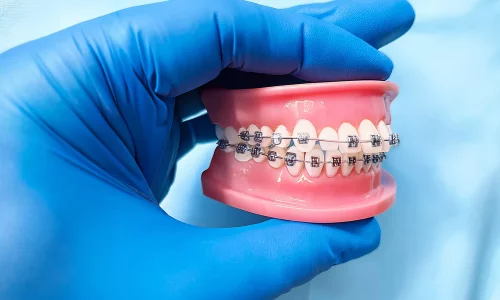
How do teeth move during orthodontic treatment (braces/Invisalign)? Learn the biology of tooth movement, how the bone and surrounding tissues (periodontal ligament) around the tooth root remodel, and the role of continuous light forces.
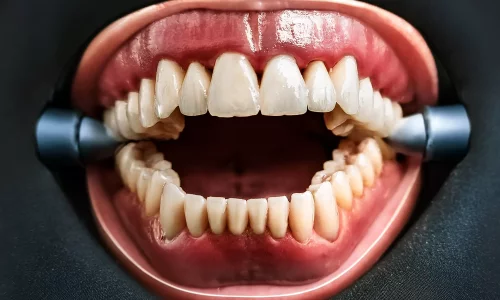
What is the difference between the "Turkey Teeth" trend and real, ethical dental treatment? Learn about the long-term risks of fast, radical aesthetic procedures and understand the importance of proper diagnosis and minimally invasive approaches in Turkish dentistry.
Milim Dental Hospital isn't just a clinic—it's where confident smiles begin. With a team of world-class specialists, advanced technology, and a patient-first approach, we turn dental care into a premium experience.
We prioritize hygiene, comfort, and tailor-made treatments designed just for you. Don’t just take our word for it—explore real stories from real patients.
Your perfect smile starts here. Join the Milim experience.


Milim Dental Hospital provides comprehensive dental services in a spacious 1,000 m² facility, supported by a wide team of dental professionals including specialists in Oral and Maxillofacial Surgery, Prosthodontics, Orthodontics, Pediatric Dentistry, and Periodontology.