Many people experiencing tooth loss ask similar questions:
These are among the most frequently asked questions about implants, both in internet searches and clinical examinations. In this article, we will address each of these questions individually, using understandable language while remaining faithful to the scientific basis of dentistry.
Let's start with the most basic question: What is a dental implant?
A dental implant is an artificial root placed into the jawbone to replace the root of a missing tooth. It is typically:
This is why the question, "Is an implant a screw?" is frequently asked by the public.
Yes and no.
Therefore, comparing it to "a metal screw bought from a hardware store" is inaccurate. An implant is a high-tech artificial tooth root, designed according to medical standards, and intended to remain in the body for many years.
No. When most patients see the porcelain or zirconia teeth on top of those who say, "I got an implant," they mistakenly believe that visible part is the implant.
However:
Although the term "implant" is used colloquially to refer to the entire structure, the implant itself is fundamentally the root component.
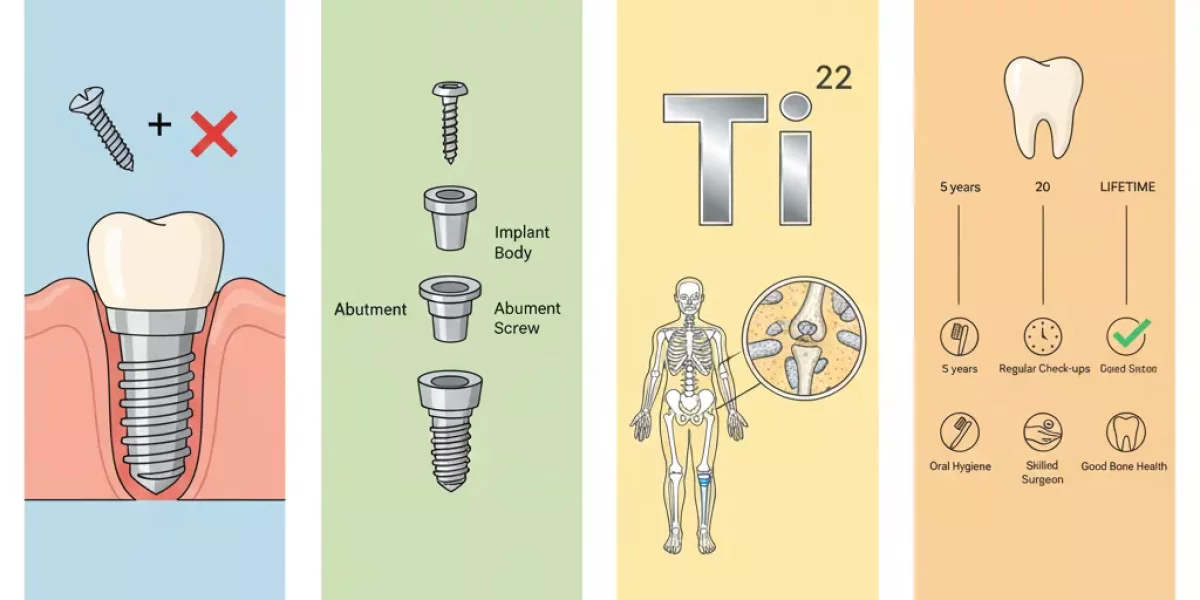
The term "implant screw" is sometimes used to describe the entire implant system, and sometimes to refer to specific components. To reduce confusion, let's clarify the main parts:
| Component | Description | Reference to "Screw" |
| Implant Body (Fixture) | The main component placed in the jawbone, acting as the tooth root. | This is what the public most commonly refers to as the "implant screw" due to its threaded shape. |
| Abutment | The connector piece between the implant body and the overlying crown/restoration. | It is secured to the implant using a small internal screw or a tightening mechanism. |
| Crown/Restoration | The visible part in the mouth that you see as the tooth (made from porcelain, zirconia, etc.). | The "screw-retained system" refers to the method of attaching the crown to the abutment or implant. |
Therefore, the question, "What is an implant screw?" can be answered as follows:
An implant screw refers to the titanium-made, screw-shaped implant body placed inside the jawbone to act as the tooth root. Furthermore, small screws that connect this body to the overlying abutment are also part of the system.
Since these terms can sometimes be confusing for patients, dentists often prefer to refer to the entire structure simply as "the implant." But from a professional standpoint, the system is multi-component.
Another frequently asked question concerns the material used for the implant.
Short Answer: Yes, the vast majority of dental implants used today are made from titanium or a titanium alloy.
Titanium is an extremely valuable metal used in medicine not only for dental implants but also for:
This is because:
Osseointegration means that bone cells attach to the implant surface, forming a tight, microscopic connection between the implant and the bone.
Titanium is an extremely suitable material, both chemically and physically, for this osseointegration process.
Yes, zirconia (ceramic) implants are available on the market; these are generally white and metal-free options. However:
Therefore, the first and most widely used material that comes to mind when talking about dental implants is still titanium and its alloys.
This is one of the most critical questions patients ask: "I'm getting an implant; how many years will it last? Is it long-lasting?"
A sincere and realistic answer is needed here.
When:
...an implant can be used for many years, even 20–30 years and beyond in many patients.
Clinical studies worldwide show that the long-term success rates of titanium implants are very high.
Many factors determine whether an implant will be "long-lasting":
As seen, the "long-lasting" nature of an implant cannot be explained solely by "being made of titanium." The entire system and the patient's habits must be evaluated together.
This question also comes up frequently. In short:
Conditions around the implant, such as:
...can develop. If left untreated, they can lead to implant loss.
Therefore: An implant won't decay, but it can be lost if not properly maintained. Just like natural teeth, it requires cleaning and check-ups.
The concept of a "screwed tooth" (vidalı diş) in common parlance also sometimes causes confusion. It is generally used in two contexts:
The crown (or bridge) placed on top of the implant can be attached to the implant body using two main methods:
These prosthetic systems are also situations referred to when people say "screwed tooth." Here again, the word "screw" indicates the engineering logic; they are not ordinary metal screws but precision medical connection components.
In this article, we answered four fundamental questions:
If you are considering getting an implant, it will be very helpful to write down your questions and ask your dentist during your first examination. Remember:
A well-informed patient feels more secure and comfortable throughout the treatment process.
Implant treatment is one of the most robust solutions, both functionally and aesthetically, for missing teeth when the right patient, the right dentist, the right planning, and the right maintenance come together.
A dental abscess is one of the most common oral and gum infections encountered in daily life. It can develop due to poor oral hygiene and, if left untreated, may lead to serious health problems. A dental abscess is an infection that occurs as a result of inflammation in the gums, tooth root, or surrounding tissues. If not treated in time, it may become chronic and develop into a cyst. By maintaining proper gum health and oral hygiene, gum abscesses and related tooth pain can be prevented.
What shapes the price of a smile makeover? Explore the key factors, from treatments to technology, that impact your budget.
A guide explaining how Invisalign attachments work and why they are needed for precise orthodontic results.
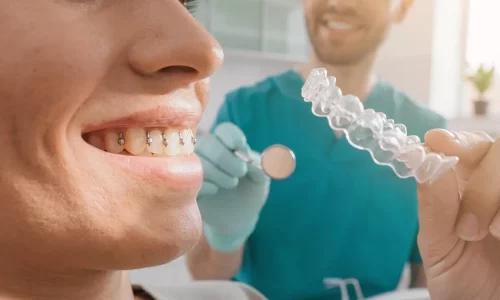
Milim Dental Hospital isn't just a clinic—it's where confident smiles begin. With a team of world-class specialists, advanced technology, and a patient-first approach, we turn dental care into a premium experience.
We prioritize hygiene, comfort, and tailor-made treatments designed just for you. Don’t just take our word for it—explore real stories from real patients.
Your perfect smile starts here. Join the Milim experience.

Milim Dental Hospital provides comprehensive dental services in a spacious 1,000 m² facility, supported by a wide team of dental professionals including specialists in Oral and Maxillofacial Surgery, Prosthodontics, Orthodontics, Pediatric Dentistry, and Periodontology.