English
Big Sale – Last Days for 20% Off!
513HOUR 34MINUTE 16SECOND
When Should Impacted Teeth Be Extracted?

When Should Impacted Teeth Be Extracted?

8 December Mon, 2025

? Explanation from Oral and Maxillofacial Surgeon Dr. Ali Direnç in Bursa: When Should Impacted Teeth Be Extracted?

Impacted teeth, especially impacted wisdom teeth (third molars), are among the most common oral and maxillofacial surgery problems experienced by both young people and adults today. Many people ask these questions:

  1. “When should impacted teeth be extracted?”
  2. “Must every impacted wisdom tooth be removed?”
  3. “Can I wait if I don’t have pain?”
  4. “When should I see an Oral Surgeon in Bursa?”

In this article, you will find detailed and understandable answers to these questions frequently encountered in the daily practice of specialists like Dr. Ali Direnç, an Oral and Maxillofacial Surgeon practicing in Bursa.

Request a Free Treatment Plan from Our Expert Doctors

By the end of the article, you will have a much clearer idea of when you need to act regarding the monitoring or extraction of your impacted teeth.

1. What is an Impacted Tooth?

An impacted tooth is a tooth that fails to fully erupt into the mouth at the expected time, remaining partially or completely "lodged" within the bone or gum tissue.

The most common impacted teeth are:

  1. Wisdom teeth (3rd molars – also known as 'Akıl Dişleri' in Turkish / 'Intelligence Teeth')
  2. Upper canine teeth (especially associated with orthodontic problems)
  3. Some premolars or, rarely, incisors

An impacted tooth can be:

  1. Fully Impacted: The tooth remains completely under the bone and gum tissue and is not visible in the mouth.
  2. Partially Impacted: A part of the tooth is visible in the mouth, while the rest remains within the bone or gum.

Partially impacted wisdom teeth, in particular, carry a high risk for both “food accumulation” and “infection.”

2. Why Do Teeth Become Impacted?

The most frequent causes of impacted teeth are lack of space and incorrect eruption direction.

The main reasons can be summarized as follows:

  1. Genetically small jawbones.
  2. An excessive number of teeth (leaving no room for the teeth that need to erupt).
  3. Wisdom teeth being positioned too far back and encountering an obstruction on their eruption path.
  4. The presence of another tooth or a supernumerary tooth in the eruption path.
  5. Certain traumas or infections during childhood.
  6. Orthopedic and skeletal jaw discrepancies.

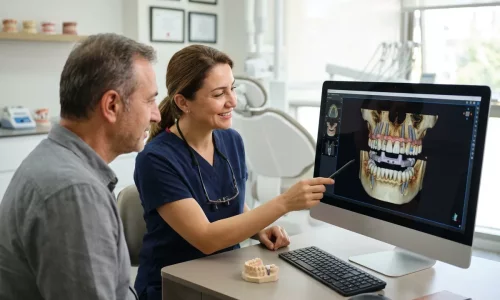
Specialists like Oral Surgeon Dr. Ali Direnç in Bursa use panoramic X-rays and 3D tomography to thoroughly evaluate the position of these impacted teeth, their relationship with adjacent teeth, and the risks they pose within the jaw.

The answer to the question, “When should impacted teeth be extracted?” is often based on these imaging findings.

3. Should Impacted Teeth Always Be Extracted?

This is a very important point.

  1. It is incorrect to say that every impacted tooth must be extracted.
  2. It is also incorrect to say that "no impacted tooth needs to be extracted, they can all stay."

The correct approach is as follows:

  1. The current status of the impacted tooth is evaluated.
  2. The risks it might pose in the coming years are calculated.
  3. The patient’s age, general health status, and complaints are taken into consideration.
  4. Based on these, a decision is made: "Extraction or Monitoring?"

An impacted tooth:

  1. May currently cause no symptoms at all.
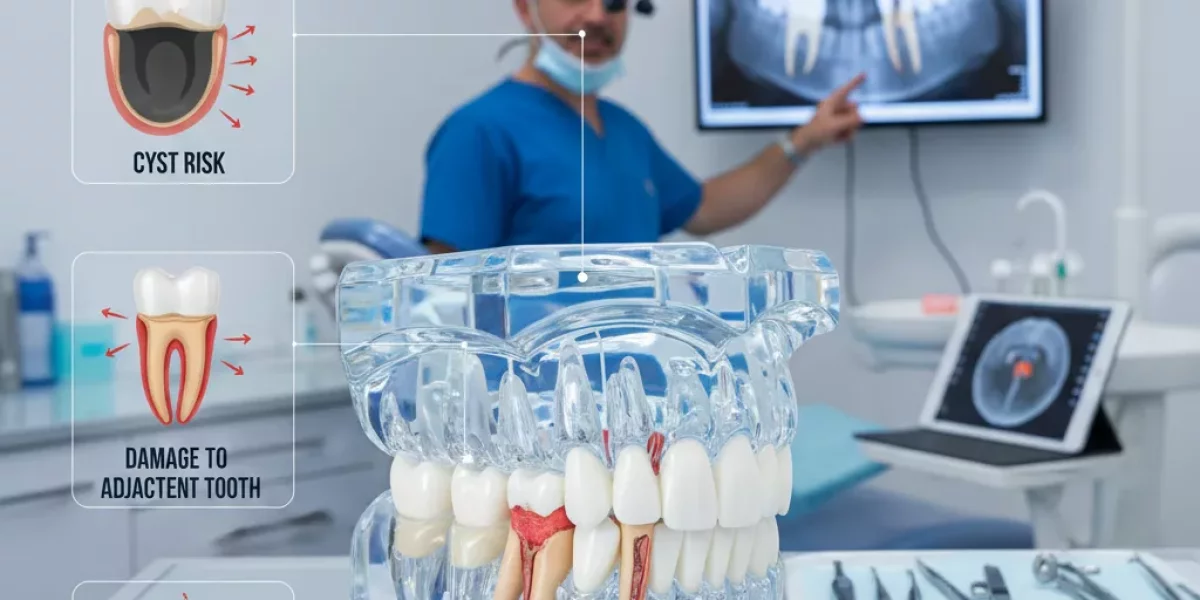
  2. But if it gives strong radiographic signals of potentially developing a cyst, damaging an adjacent tooth, or initiating decay, early extraction may be recommended.

In summary:

The treatment decision is made not by asking, “Are there symptoms?” but by asking, “What are the radiographic and clinical risks?”

4. When Should Impacted Teeth Be Extracted?

Conditions Where Extraction Should Not Be Delayed

Now, let's get to the main question: When should impacted teeth be extracted?

If even one of the following conditions is present, the decision to extract is usually not delayed, and a referral to an oral surgeon is made.

4.1. If there is frequent infection and pain (Pericoronitis)

The gum flap covering a partially impacted wisdom tooth can lead to:

  1. Accumulation of food debris.
  2. Bacterial proliferation.
  3. An infection called pericoronitis.

Symptoms include:

  1. Throbbing pain at the back of the jaw.
  2. Difficulty chewing and opening the mouth.
  3. Swelling of the lymph nodes under the jaw.
  4. Bad breath.
  5. Sometimes fever and general malaise.

If this condition recurs, it indicates that the impacted tooth is not "peacefully coexisting."

In this situation, specialists like Oral Surgeon Dr. Ali Direnç in Bursa usually recommend the extraction of the impacted tooth.

4.2. If it is damaging an adjacent tooth

Impacted wisdom teeth can lean against the tooth in front of them (the 2nd molar – number 7), potentially causing:

  1. Pressure on the root of that tooth.
  2. Initiation of root resorption (erosion) in that area.
  3. A predisposition to decay in the adjacent tooth.

If the panoramic X-ray shows:

  1. The impacted tooth "pushing" against the root of the adjacent tooth.
  2. Thinning of the roots of the adjacent tooth.

...the impacted tooth needs to be extracted before further loss occurs.

4.3. If there is suspicion of a cyst or tumor

Over time, the tissues surrounding impacted teeth can develop:

  1. Cysts (e.g., dentigerous cyst).
  2. Much more rarely, tumors.

These cysts can:

  1. Erode the jawbone from within.
  2. Damage surrounding teeth and nerve tissue.
  3. Increase the risk of jaw fracture in the long term.

If the radiographic examination around the impacted tooth shows:

  1. A large radiolucent (dark) area.
  2. Findings of a cystic lesion.

...an experienced oral surgeon in Bursa, such as Dr. Ali Direnç, will recommend the surgical removal of the tooth and the cystic tissue.

4.4. If it negatively affects orthodontic treatment

In patients planned for orthodontic treatment (braces), impacted wisdom teeth can lead to:

  1. The teeth shifting back again.
  2. Recurrence of crowding.
  3. Decreased stability of the orthodontic treatment.

For this reason, orthodontists may recommend the extraction of impacted teeth before treatment, especially if the lower wisdom teeth are impacted and causing pressure.

4.5. If it triggers jaw joint and muscle pain

While a purely indirect effect, some impacted teeth can contribute to increased temporomandibular joint (TMJ) pain by:

  1. Disrupting the chewing plane.
  2. Affecting the bite (occlusion).
  3. Disturbing muscle balance.

In such cases, an oral surgeon, dentist, and, if necessary, a physical therapy specialist evaluate the situation together. If extracting the impacted wisdom tooth is expected to correct the chewing balance, the extraction may be recommended.

4.6. If there is a plan for implants, prosthetics, or other surgery

In the near future, if:

  1. Implants are to be placed.
  2. A fixed bridge prosthesis is planned.
  3. Full-arch implant treatments like All-on-4 / All-on-6 are considered.

...the position of the impacted wisdom teeth must be evaluated.

Impacted teeth that might put pressure on the future implant area, reduce jawbone volume, or create a risk of infection are considered like a “silent bomb posing a future risk” and their extraction is recommended during the planning phase.

5. Impacted Tooth Extraction by Age: When Is It More Advantageous?

An important part of the answer to the question, "When should impacted teeth be extracted?" relates to age.

5.1. Ages 16–25: The most advantageous period for healing

Generally:

  1. Wisdom teeth attempt to erupt between the ages of 17 and 25.
  2. This age range is when the roots are either complete or nearing completion.

During this period:

  1. The roots are not yet excessively long and curved.
  2. The bone is more elastic, and the healing potential is higher.
  3. Proximity to nerve tissue is generally less than in older age groups.

Therefore, specialists like Oral Surgeon Dr. Ali Direnç in Bursa usually consider the age range of 18–25 as the ideal period for the extraction of impacted wisdom teeth.

5.2. After age 25: Extraction is possible, but risks slightly increase

After age 25:

  1. Tooth roots are fully developed.
  2. Roots may become thicker, hooked, or closer to the nerve.
  3. Bone density increases, and flexibility decreases.

This does not make extraction impossible; it only means:

  1. The surgical time may be slightly longer.
  2. The healing process may be slightly slower.
  3. If there is close proximity to a nerve, the risk of numbness becomes slightly more significant.

Nevertheless, impacted teeth can be successfully extracted in this age group as well. The important thing is that the extraction is planned by an experienced oral surgeon using ideal imaging (especially 3D tomography).

5.3. Age 40 and over: Selective approach

In patients over 40, impacted teeth:

  1. May have remained silent for many years.
  2. Or may come to the forefront later due to problems like cysts or infections.

In this age group:

  1. Bone elasticity is lower.
  2. Systemic diseases (diabetes, hypertension, use of blood thinners, etc.) may be more common.
  3. Healing may be slightly slower.

For this reason, teeth that are not causing problems, are completely impacted, and show no risk factors may sometimes only be monitored in patients over 40.

However, in cases of:

  1. Suspected cyst.
  2. Pressure on an adjacent tooth.
  3. Frequent infection.
  4. Implant/prosthetic plan.

...extraction may be indicated regardless of age.

6. How is an Impacted Tooth Evaluation Done with an Oral Surgeon in Bursa?

An oral surgeon in Bursa, such as Dr. Ali Direnç, usually follows these steps when evaluating your impacted teeth:

  1. Detailed History:
  2. How long have you had pain?
  3. Have you had to use antibiotics or painkillers before?
  4. Have you experienced difficulty swallowing, opening your mouth, or jaw locking?
  5. Clinical Examination:
  6. Redness, swelling, or bad breath in the gums.
  7. Food accumulation around the partially impacted tooth.
  8. Tenderness in the jaw joint, pain in the muscles.
  9. Panoramic X-ray:
  10. The angle of the tooth (horizontal, angled, vertical).
  11. Its relationship with the adjacent tooth.
  12. Its distance from the nerve canal.
  13. 3D CBCT (Tomography) if necessary:
  14. Especially for 3rd molars very close to the nerve.
  15. In cases of suspected cysts.
  16. For teeth with asymmetrical and complex roots.
  17. Risk-Benefit Analysis:
  18. Complaints, age, systemic diseases, future plans (implants, etc.) are evaluated together.

And finally, the following question is answered:

“Will this impacted tooth cause you more harm now and in the future, or is it more rational for it to stay in place?”

If the answer to this question is “high potential for harm,” then the time for extraction has come.

7. Is Impacted Tooth Extraction a Difficult and Very Painful Procedure?

Impacted tooth extraction is a procedure that is widely feared by the public.

However, today, thanks to:

  1. Local anesthesia (regional numbing).
  2. Sedation if necessary (a mild state of sleep).
  3. Modern surgical instruments (e.g., piezo surgery).

...you are not expected to feel pain during the procedure.

Impacted tooth extraction:

  1. May take 10–20 minutes for a simple position.
  2. May extend up to 30–60 minutes for complicated positions.

Post-procedure, you will experience a process that can be managed more comfortably with:

  1. Swelling that decreases within 2–3 days.
  2. The need for painkillers in the first few days.
  3. Ice application and soft foods.

Surgeons with extensive experience in this field, such as Oral Surgeon Dr. Ali Direnç in Bursa, employ a planned and predictable surgical approach, especially for complex impacted teeth, to:

  1. Minimize the risk of nerve damage.
  2. Avoid unnecessary removal of excessive bone.
  3. Treat soft tissue delicately.

8. Potential Consequences of Delaying Impacted Tooth Extraction

Many patients say, “I’m managing for now, it goes away with antibiotics, I'll postpone the extraction.”

However, constantly delaying impacted tooth extraction carries certain risks:

  1. Recurrent Infections: Each episode of infection puts an added burden on surrounding tissues and your immune system.
  2. Irreversible Damage to the Adjacent Tooth: Root resorption and deep decay can lead to the loss of a healthy tooth in the future.
  3. Cyst Formation: A cyst that is small initially can grow over the years, causing greater bone loss and necessitating a larger surgery.
  4. More Difficult Surgery in Older Age: An extraction that could be relatively easy today may become more complex 10–15 years later due to bone and systemic conditions.

Therefore, it is important for patients living in Bursa or coming to Bursa for treatment to:

  1. See an oral surgeon when they first experience a problem with their impacted teeth.
  2. Make the decision of “monitoring or extraction?” without delay.

9. Frequently Asked Questions – Quick Answers

QuestionAnswer
1. I have an impacted tooth but no symptoms, should I still have it pulled?This cannot be answered without an X-ray and tomography. Some impacted teeth can be monitored without problems, while others can silently initiate cysts or root damage. Oral surgeon consultation is essential.
2. Who should I see for impacted tooth extraction in Bursa?This procedure is generally performed by Oral and Maxillofacial Surgery specialists. You can schedule an appointment with specialists like Oral Surgeon Dr. Ali Direnç who work in this field in Bursa.
3. Should all my impacted wisdom teeth be extracted?It varies for every patient. Some wisdom teeth can be monitored without issues, while others must be extracted. The evaluation is individual.
4. How long does it take to heal after impacted tooth extraction?Return to daily life is usually possible within the first week. Complete soft tissue healing takes a few weeks, and bone healing takes a few months.
5. Do impacted teeth cause jaw misalignment or facial asymmetry?They usually do not cause direct jaw misalignment, but they can have indirect effects by disrupting chewing habits. Skeletal asymmetry is mostly related to other factors during the growth period.
6. Can impacted tooth extraction be done during pregnancy?In mandatory cases, some procedures can be performed under local anesthesia with careful planning during the second trimester of pregnancy (months 3–6). However, planned surgeries are postponed until after pregnancy if possible. A joint decision by the obstetrician, oral surgeon, and dentist is necessary.

10. Conclusion: When Should Impacted Teeth Be Extracted?

At the end of this lengthy explanation, the one-sentence summary for the question, “When should impacted teeth be extracted?” is as follows:

Impacted teeth should be extracted by an oral surgeon without delay—considering age, systemic condition, and radiographic findings—if they carry risks such as infection, pain, damage to an adjacent tooth, cyst formation, disruption of orthodontic treatment, or obstruction of implant/prosthetic plans.

If you live in Bursa or are considering coming to Bursa for treatment, you can schedule an appointment with an expert in this field, such as Oral Surgeon Dr. Ali Direnç, to:

  1. Clarify the status of your impacted teeth.
  2. Learn whether monitoring or extraction is necessary.
  3. Plan the most appropriate timing for you.

Impacted teeth can remain silent for years, but like a problem that erupts at the wrong time, they can put you in a difficult situation.

With early diagnosis, proper planning, and an experienced oral surgeon, managing this process in a controlled and safe manner is within your reach.


A Milim
Makes a Big Difference

Milim Dental Hospital is the first dental centre to receive the "Health Tourism Authorisation Certificate" issued by the Ministry of Health of the Republic of Turkey.
All Articles
What Makes All-on-X a More Flexible Option for Full-Arch Restoration?
east

All-on-X offers unmatched flexibility in dental implant procedures, allowing for a customizable number of implants—ranging from 4 to 6 or more—based on individual needs. Ideal for complex cases, it provides enhanced stability, comfort, and a personalized treatment approach.

Requirements for a Beautiful Smile: Hollywood Smile
east

Cosmetic dentistry includes elective dental procedures designed to improve the appearance of stained, uneven, misshapen, or discolored teeth, helping you achieve the beautiful smile you deserve. With aesthetic dental treatments, you can enhance the appearance of your teeth and reach the most suitable treatment for your needs.

Smile Makeover in Turkey: How Milim Dental Helps You Gain Confidence Again
east

In a world where first impressions matter, your smile is one of your most powerful assets. But what if your teeth make you feel self-conscious rather than confident? The good news is, you’re not alone—and even better, there’s a solution. A complete smile makeover in Turkey, especially with Milim Dental in Bursa, can transform not just your appearance but your entire self-esteem.

Why Patients
Choose Milim?

Milim Dental Hospital isn't just a clinic—it's where confident smiles begin. With a team of world-class specialists, advanced technology, and a patient-first approach, we turn dental care into a premium experience.
We prioritize hygiene, comfort, and tailor-made treatments designed just for you. Don’t just take our word for it—explore real stories from real patients.
Your perfect smile starts here. Join the Milim experience.
View All Experiences
play_arrow
Dt. İsmail Özkısaoğlu Dentist
Get a Free Consultation
play_arrow
Dr. Dt. Ali Direnç Ulaşan Oral, Dental, Maxillofacial Surgeon
Get a Free Consultation
play_arrow
Dr. Dt. Ali Direnç Ulaşan Oral, Dental, Maxillofacial Surgeon
Get a Free Consultation

Milim Dental Hospital provides comprehensive dental services in a spacious 1,000 m² facility, supported by a wide team of dental professionals including specialists in Oral and Maxillofacial Surgery, Prosthodontics, Orthodontics, Pediatric Dentistry, and Periodontology.

Our clinic is authorized by the Turkish Ministry of Health for International Health Tourism. This website is intended only for informing patients from abroad. It does not contain advertisements and complies with legal privacy regulations.
Milim Dental Hospital © 2025 - All rights reserved.

Have a Question on Your Mind?

At Milim Dental Hospital, we accept a maximum of 10 international patients per month. This allows us to provide each patient with personalized care and the highest quality of treatment. Let us know how we can help you!

Would you like to see real patient results? Feel free to explore our Case Gallery!

Change Site Language

English
Big Sale – Last Days for 20% Off!