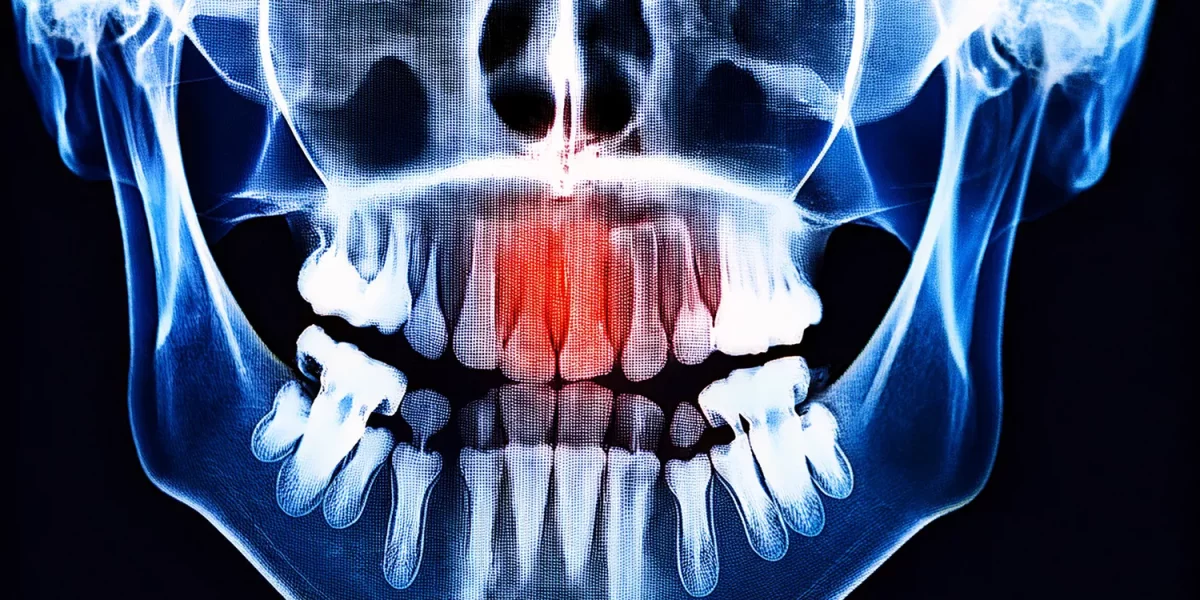
You go for a dental check-up, and a panoramic X-ray (a large jaw X-ray) is taken.
The report states:
"A radiolucency (shadow) is observed in the right lower jaw region. Further examination is recommended for differentiation between a cyst/tumor."
And the only thought going through your mind is:
"Do I have a tumor? Am I cancerous?"
As a surgeon specializing in maxillofacial surgery in Bursa, I, Dr. Ali Direnç Ulaşan, and the Milim Dental team, see many patients who come to the clinic every day with exactly this worry.
In this article, I want to explain in a language that the public can understand that the "shadow" seen on a panoramic X-ray:
First, let's clarify a basic point: The panoramic X-ray is the most common general screening X-ray used in dentistry, showing the entire mouth and jaws in a single image.
In this film:
Therefore, the term mentioned in the report:
"Radiolucency" or "radiolucent area" simply means "a dark-appearing region on the X-ray."
This dark area can sometimes be:
So, the phrase "there is a shadow" alone does not mean you have cancer. But it is a finding that should be taken seriously and evaluated by an oral and maxillofacial surgeon.
A jaw cyst is a cavity within the jawbone or associated with tooth roots, filled with fluid or semi-fluid material, and surrounded by a thin membrane.
There are various types of jaw cysts, but their fundamental characteristics are:
Common types of cysts (in lay terms):
The key takeaway here is: Not every jaw cyst is cancer; the vast majority are benign.
However, if left untreated, they can:
Therefore, it is not correct to leave them simply because they are "benign."
Tumor is a general word we use for masses formed by uncontrolled cell proliferation. We classify them into two main categories:
A significant portion of tumors seen in the jaw area are benign.
Malignant jaw tumors and oral cancers are more commonly encountered in patients who:
Therefore, not every "shadow" seen on a panoramic X-ray during a routine check-up, when you have no complaints, means a "malignant tumor." However, the way to distinguish whether it is a cyst, a tumor, or a normal cavity is through detailed examination.
Jaw cysts and some tumors can remain completely silent for a long time. This is why they are often not noticed until a routine panoramic X-ray is taken.
Sometimes, however, they can cause the following complaints:
Much more rarely:
If you have such complaints, you must be evaluated by an oral and maxillofacial surgeon.
The first thing I do with patients who come to Milim Dental in Bursa is:
This step is crucial for combining the clinical findings with the shadow we see on the radiology.
The panoramic X-ray gives us a general map. However, it is often insufficient on its own to determine the type of lesion. Therefore, especially in suspicious cases, we recommend getting a:
Thanks to CBCT, we can see in 3D:
Some types of cysts have typical appearances on radiographs (e.g., a well-defined, rounded space around an impacted wisdom tooth). Nevertheless, it is not always possible to say "it is 100% this just by looking at the radiological image."
The actual critical differentiation lies here: "Is it a cyst, a tumor, benign, or malignant?"
The clear answer to this question is provided by the pathology laboratory. This means we surgically take a sample from the lesion (biopsy) or remove it completely; the tissue sample is then examined under a microscope.
Is a biopsy harmful?
The most common concern I hear from the public is: "Doctor, will it spread if you take a biopsy?"
No. A biopsy performed with the correct technique will not cause the disease to spread. On the contrary, by clarifying the diagnosis, it can prevent unnecessarily large surgeries.
In most cases of jaw cysts and benign tumors:
The treatment plan is determined based on:
The most common procedures we perform are:
In some cases, the cavity created by the cyst may be supported with bone graft (bone powder). In the long term, once the area has recovered, implant planning can be done if necessary.
For benign jaw tumors, the goal is usually to:
If the pathology result indicates a malignant tumor:
Early detection of these cases is vitally important. Therefore, if you have:
you should consult a specialist without delay.
Don't panic, but don't ignore it either. A shadow does not always mean "tumor," but it requires detailed examination.
At Milim Dental, we typically manage the process for patients presenting with suspected jaw cysts or tumors as follows:
1) If a shadow appeared on the panoramic X-ray, is it definitely a cyst?
No. The shadow could be a cyst, tumor, normal cavity, anatomical variation, or an inflammatory focus. Clinical examination, CBCT, and biopsy (if necessary) are essential for clear differentiation.
2) If I have a cyst, do I have to have surgery immediately?
It depends on the type, size, and effect on surrounding tissues. While small, incidentally found lesions can be monitored, surgery is necessary for cysts that pose a risk of bone fracture, push teeth, or approach structures like nerves and sinuses. You will make this decision with your oral and maxillofacial surgeon.
3) I am afraid of having a biopsy; will it spread?
A biopsy taken with the correct surgical technique will not cause the disease to spread. On the contrary, it ensures an accurate diagnosis, preventing unnecessary or inadequate treatments.
4) Can a jaw cyst recur?
Some cyst types (e.g., keratocyst) have a higher risk of recurrence than others. Therefore, we recommend regular check-ups based on the cyst type in your pathology report. Regular follow-up allows us to catch any potential recurrence early.
5) What if it turns out to be malignant?
If the pathology result shows a malignant tumor, we will refer you to a process managed collaboratively by the oral and maxillofacial surgery, oncology, and, if necessary, plastic surgery teams. Early diagnosis significantly increases the chance of treatment and quality of life. Therefore, early consultation and not avoiding a biopsy are very important.
In summary:
For a definitive diagnosis, the safest route is: oral surgeon examination + 3D tomography + biopsy (if necessary).
If you have:
As Dr. Ali Direnç Ulaşan and the Milim Dental team, specializing in oral and maxillofacial surgery in Bursa, we are here to create the most accurate diagnosis and treatment plan for you together.
This article was prepared not to scare you, but to calm you with information and encourage informed action. The best decision is always made through timely professional examination.
A guide explaining how bite issues affect the difficulty and planning of Invisalign or braces treatment.
A guide on the recommended daily wear time for clear aligners to achieve optimal teeth alignment.

A guide on how many hours per day you should wear clear aligners for optimal teeth alignment.

Milim Dental Hospital isn't just a clinic—it's where confident smiles begin. With a team of world-class specialists, advanced technology, and a patient-first approach, we turn dental care into a premium experience.
We prioritize hygiene, comfort, and tailor-made treatments designed just for you. Don’t just take our word for it—explore real stories from real patients.
Your perfect smile starts here. Join the Milim experience.

Milim Dental Hospital provides comprehensive dental services in a spacious 1,000 m² facility, supported by a wide team of dental professionals including specialists in Oral and Maxillofacial Surgery, Prosthodontics, Orthodontics, Pediatric Dentistry, and Periodontology.